
Category Archives: Uncategorized
Ziti the Noodle Dog Retires from Competitive Dog Sports
When Ziti suddenly had trouble using her rear legs, an MRI revealed multiple areas of intervertebral disc disease (IVDD), a problem that often affects beagles. She had a 2.5 hour back surgery on January 22 and was not able to come home until January 25. Ziti started rehabilitation and acupuncture the following week and is now, after 9 weeks, able to walk, run, and climb logs normally. She does not currently have total control of her legs, but we are working on this and it should improve with time. Because of this condition, Ziti has retired from agility and FastCAT in order to avoid injury associated with jumping and chasing objects. So, Ziti will just have to go back to being a dog that goes to the park on weekends instead!
Meanwhile, here’s a collection of Ziti’s athletic career highlights:


Left: Ziti having a great time on a FastCAT run in Ohio. Right: Ziti and Charissa at the 2022 FastCAT Invitational in Orlando.


At left, Ziti taking a jump at an agility trial and at right, Ziti leaping into the table.


At left, Ziti powers through the weave poles and at right, posing with her ribbons after a perfect day on January 6, 2024.
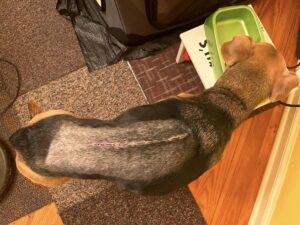

At left, Ziti’s scar shows how extensive her surgery was and at right, Ziti gets some sun therapy after a morning rehab session.
HDC Starts Work on the Historic Hayes Henderson House in Columbus
HDC is working with Design Group to prepare an assessment and feasibility study of the Hayes Henderson House for the OSU Wexner Medical Center East Hospital. The Georgian Style brick house was constructed between 1856 and 1870 on what was a 66-acre farm in 1876. After Ohio governor Rutherford B. Hayes left office in 1873, he formed a partnership with other investors to acquire the property and subdivide it as the Hayes Addition. The project likely stalled after Hayes was elected president of the United States in 1876. The Hayes Addition was not officially platted until 1896, well after Hayes’ death in 1881. The plat left the house on a 1.5-acre site with the rest of the parcel divided into less than 0.10 acre lots. By 1922 two duplex houses had been built east of the house and all three buildings were apparently for rent.
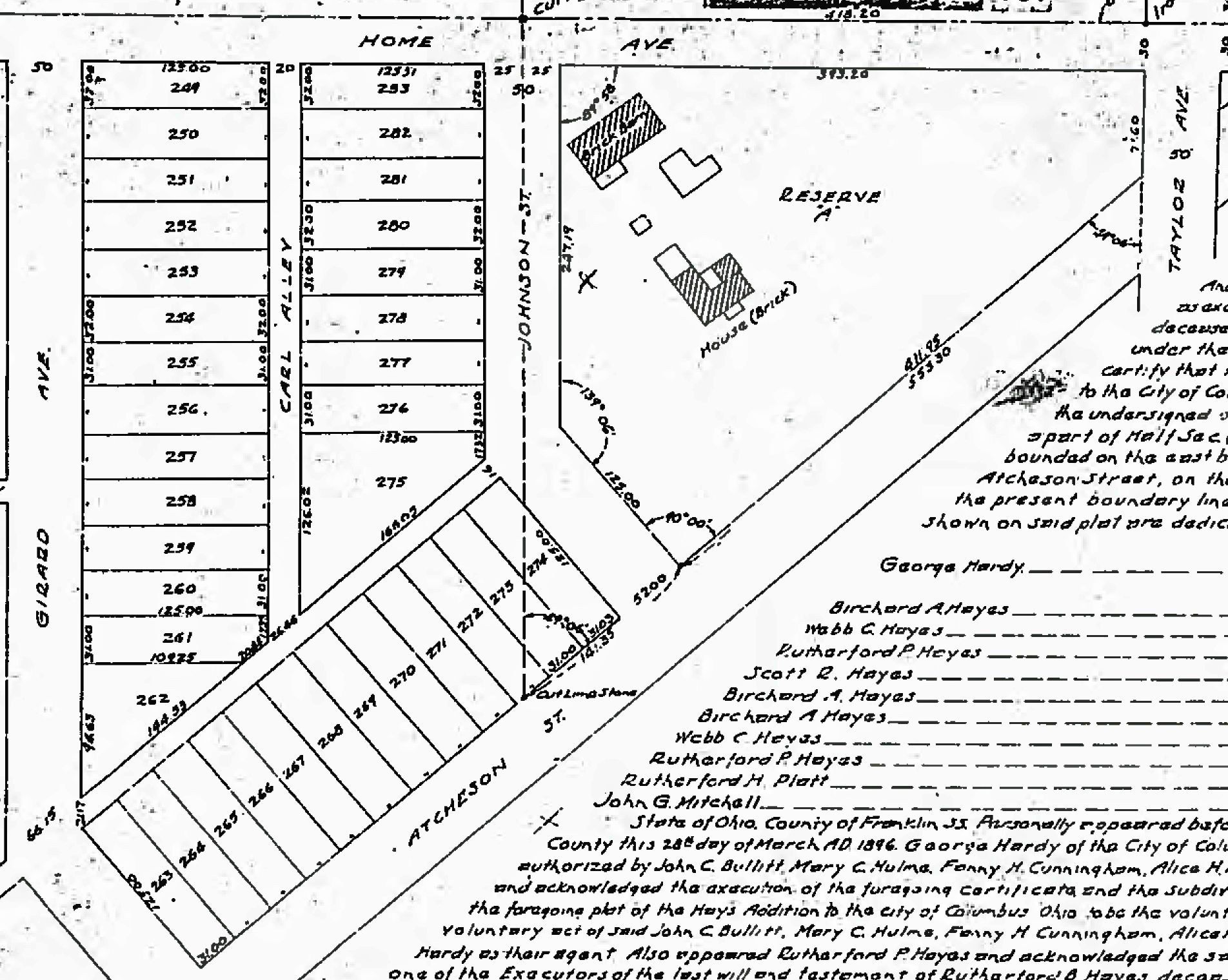
1896 Plat of the Hayes Addition
In 1942, Leonard Pearl Henderson, a prominent Black lawyer for the city’s Probate Court, purchased the property and lived there with his wife, singer Mary Ferne Henderson, and young daughter LeNora Henderson. Leonard P. Henderson graduated from the OSU College of Law in 1916, just four years after Clarence A. Jones, the first Black graduate of the College of Law. The Hendersons made many improvements to the house through the 1950s, including the addition of the two sunrooms and raising the front porch to two stories. The family also hosted many Black entertainers and celebrities who traveled to Columbus, including singer Cab Calloway and basketball player Wilt Chamberlain. LeNora “Lee” Johnson, who became a New York model and designer, inherited the house in 1987, made many improvements, and opened the house as the first Black-owned bed and breakfast in the State of Ohio in 1995. Upon her retirement in 2017, the property was sold to Blueprint Community Development LLC before being acquired by The Ohio State University in 2021 with the intention of demolishing the buildings and constructing a new rehabilitation center. After public outcry at the demolition, OSU agreed to move the rehabilitation center to another site and find an alternate use for the historic house.
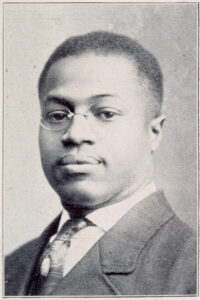 Leonard Pearl Henderson
HDC is currently working to provide recommendations and cost estimates to rehabilitate the house into four possible uses: a learning/activity center focused on youth, health provider/researcher-in-residence housing, non-profit/social service hub office, or small business use.
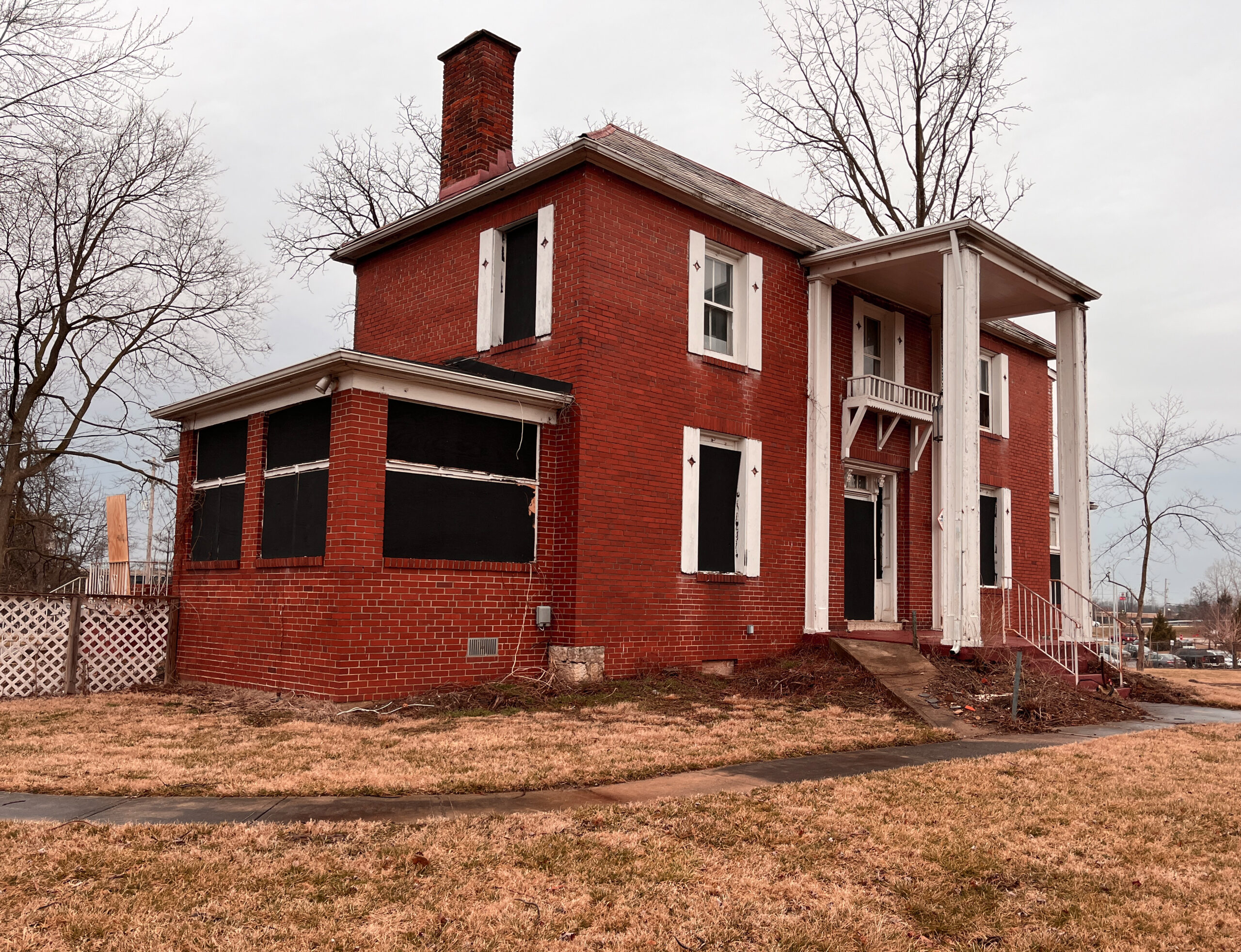
Southwest corner of the Hayes Henderson house in February 2024.
The Advantages of National Register Listing
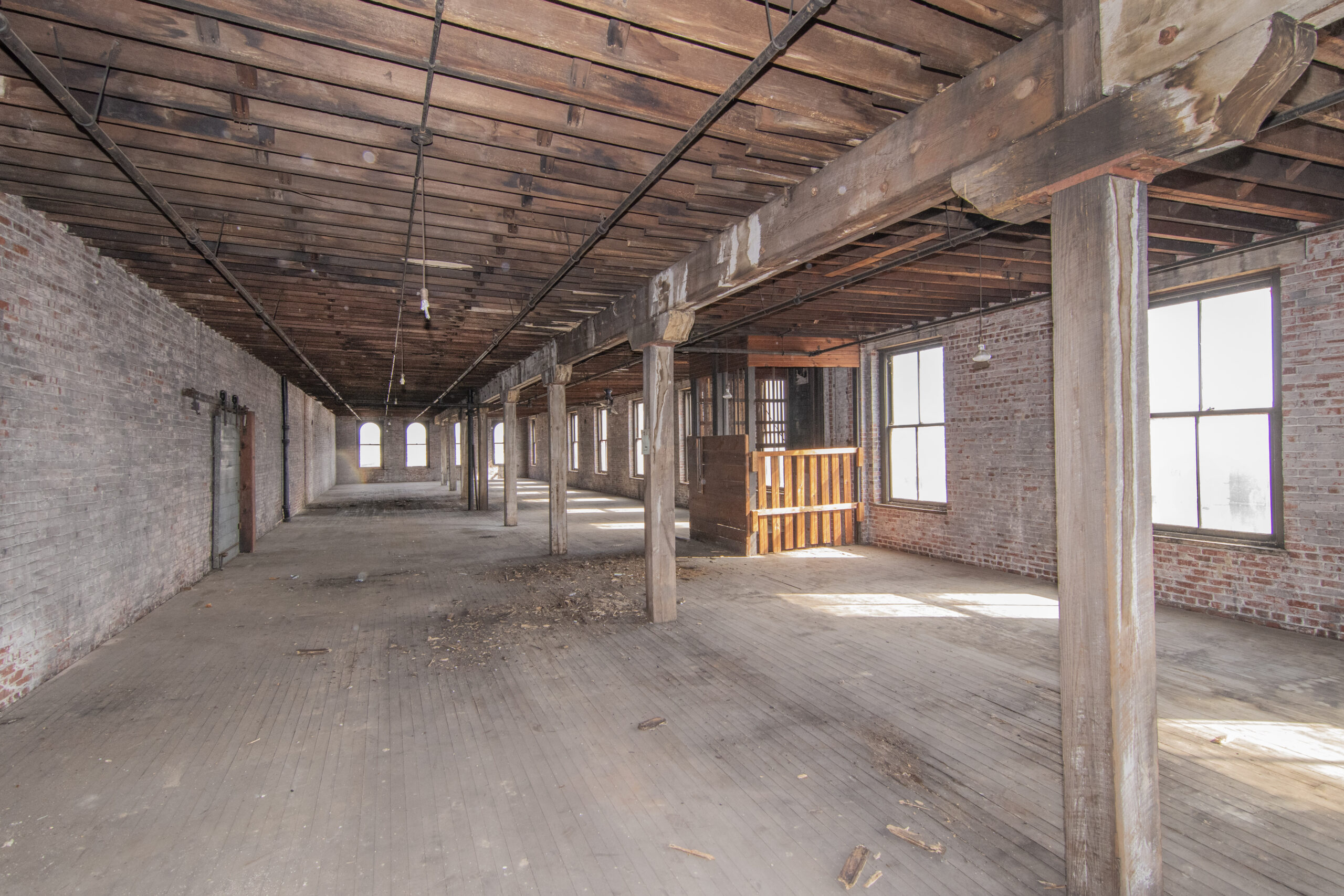
Interior of the Baker Brothers Wholesale Grocery building in Zanesville, Ohio, which was listed in the National Register in March 2023.
We have all seen markers on historic properties, indicating that this building is listed in the National Register of Historic Places (NRHP). What you may not know is what goes into getting those properties listed and what the advantages or seeming disadvantages might be to doing so. As a historic architecture firm, we have worked with countless clients to document and nominate their properties for the NRHP. Here is a list of some of the most common advantages, concerns and commonly asked questions we have observed in our line for work.
-
Your property is eligible for the 20% state historic tax credit and the 20% federal historic tax credit, which can make the difference in being able to fund a historic building renovation. Many owners who have a project ready to go run into a delay if their property is not actually listed, as simply being eligible or in the process of being listed in not sufficient.
-
If there is a federally funded road project in your area, adverse impacts to your historic property must be considered. This is true for any building that is eligible, but listed buildings receive special consideration.
-
Being listed does not mean you cannot do what you want to your property. If the project does not use federal funding either directly or indirectly through the state, nor does it require federal permits, then you can do whatever you want, up to and including demolition. However, local preservation ordinances are often stricter and require design review and approval before a project can proceed.
-
As a historic building, your renovation project may be eligible for more lenient building permit reviews. In many jurisdictions, a listed historic building allows alternative compliance methods to comply with the spirit of the building code, which can be more cost effective than following the letter of the building code.
-
Historic buildings are often eligible for private grant funding. If your building is listed due to national significance and not just local or regional significance, it may be eligible for additional grant funding from private organizations.
Many states even have grant programs to pay for the research and preparation work. Here in Ohio the grants are through the Ohio Department of Development in the amount of $4,000 for an individual building and $12,000 for a district, with the main restriction being that the owner of the property cannot also be the entity being paid to do the work. So go ahead and get your historic building or district listed!
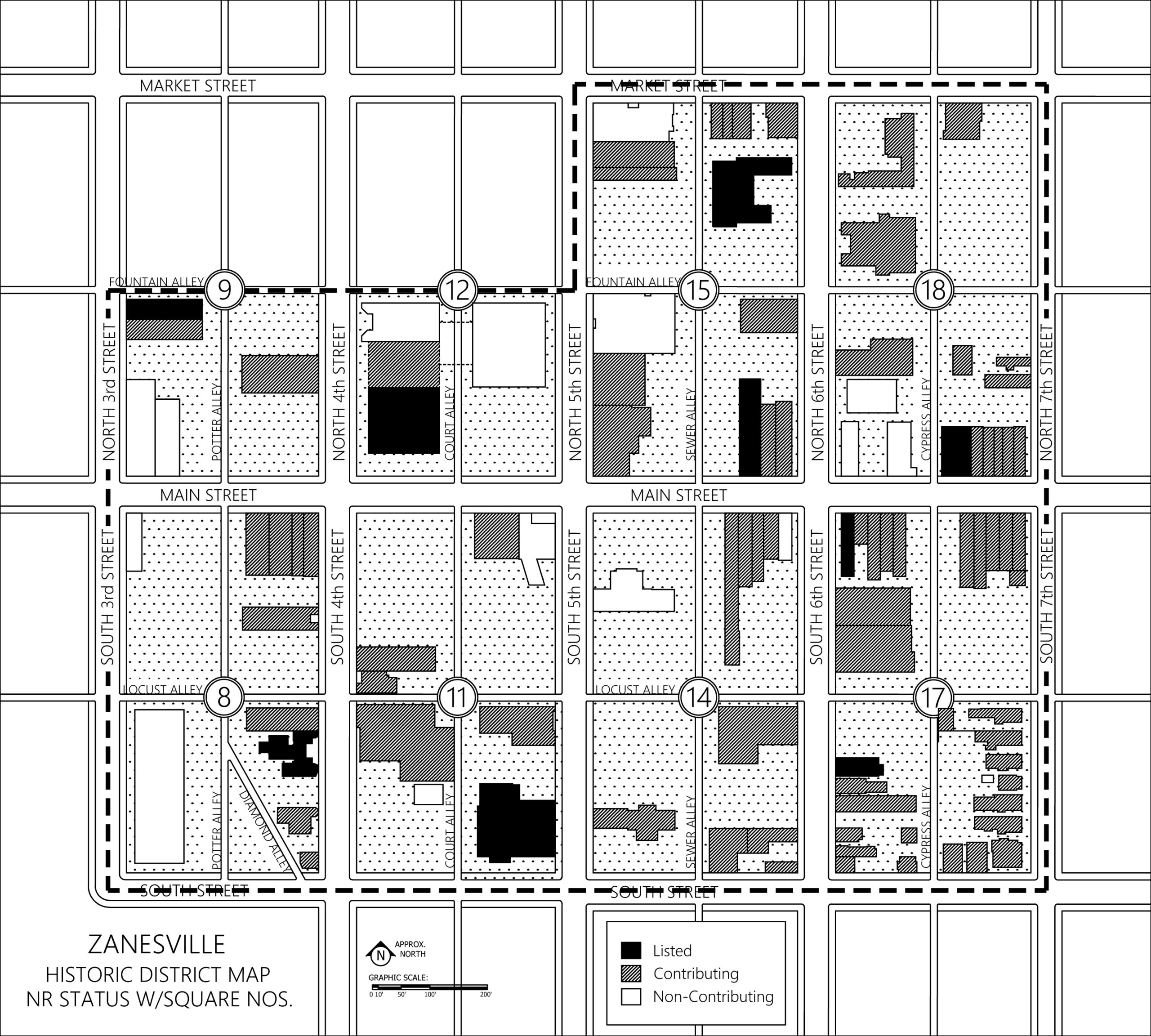
Map of downtown Zanesville’s historic district showing building status, one of three maps prepared by HDC for the district nomination, which was listed in the NRHP on February 15, 2024.
HDC Designs a New Building for ODNR
HDC was commissioned by the Ohio Department of Natural Resources to design a new storage facility in Fernwood State Forest in Jefferson County. The new building will sit next to the existing pre-fabricated metal storage building that features three bays with overhead doors. The pre-fabricated new building will have four bays with overhead doors, one of which will also have an overhead door on the back, which will allow ODNR to pull trucks and trailers into the building to load and unload equipment out of the weather. The project also features a rainwater harvesting system to be used to wash vehicles. The project is projected to bid this spring with construction completed this year. Although this is not a typical HDC project, ODNR is a fantastic client and Ziti loves going to their project locations!
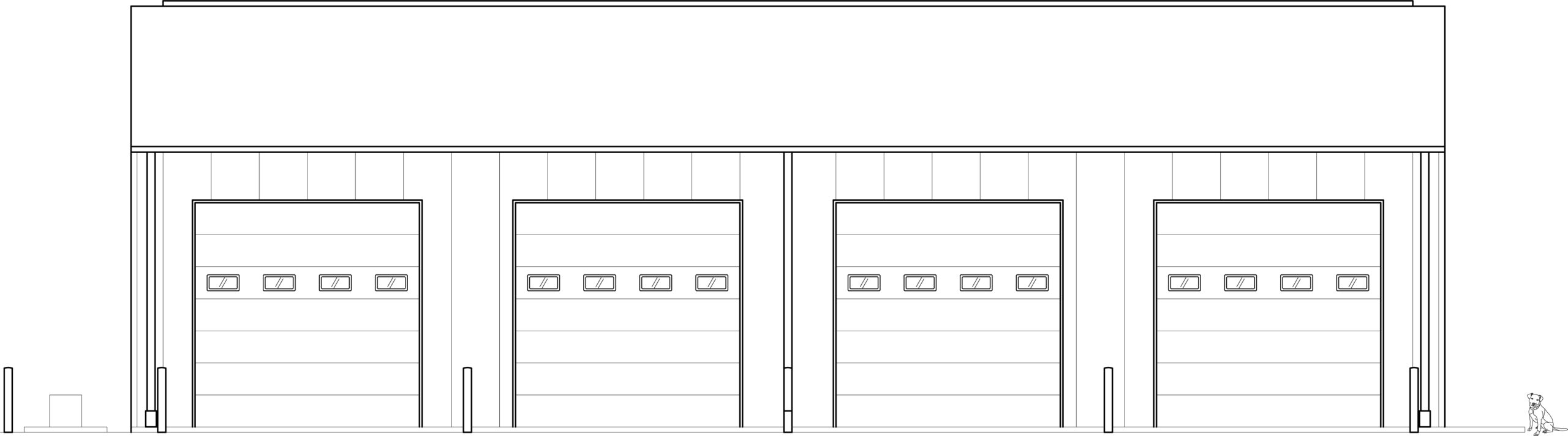
Proposed front elevation (with Ziti) of the Fernwood State Forest Storage Building in Jefferson County, Ohio.
 Left: Ziti goes back to Flagler beach and still cannot appreciate the ocean. Right: We revisit the sweet shop in town to pick up some snacks.






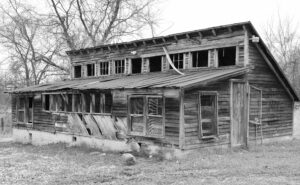 Jeff Bates photo of the southeast corner of the Taylor Farm Laying House
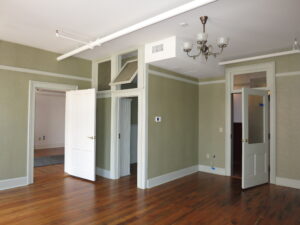 Second floor of the Woodward Opera House with reconditioned historic corridor door at right and new interior suite door at left