
Category Archives: Architecture
What Do We Do With All This Water?
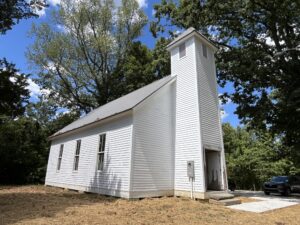
When Intel decided to build a plant in Ohio, one of the reasons is the abundance of water. Apparently, data centers keep getting built here for the same reason. But it you are working on an old building with a basement, all that water can be a liability! At The Gardner House, Steller Construction finished installing the underpinning, new concrete slab floor, and exterior perimeter drain when a torrential downpour saturated the site. Rain came down so fast that the drainage system couldn’t get water out fast enough to prevent it from entering the basement. One solution is to add a drainage mat on top of the waterproofing to keep water off the exterior wall and direct it down to the drain pipe.
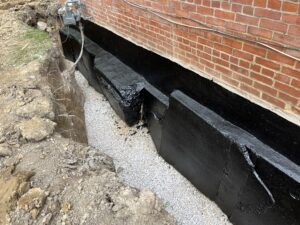
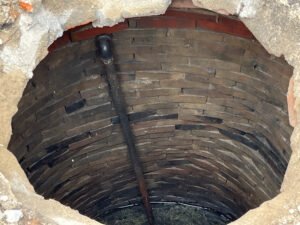
L: New fluid-applied waterproofing membrane that will be augmented with a drainage mat against the wall. R: An exiting cistern filled with water that we hope can be made into a historical exhibit that the pubic can view.
At Fernwood State Forest, the foundation drilling team working with E. Mullins Construction hit water that required the use of steel caissons to stabilize the shafts walls before the concrete could be poured. As an option, the driller could have eliminated caissons and used a slurry product known as “construction mud” (amongst other colorful names) in the shafts to keep the walls stable as concrete was being poured.
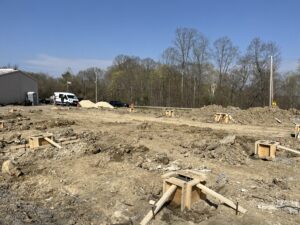
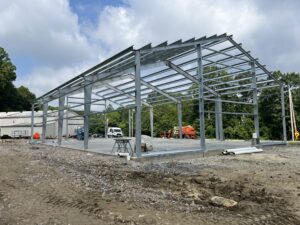
L: The Fernwood State Forest storage building in April 2025 with concrete piers curing in wood formwork. R: In July 2025, the floor slab in place and building framing up and anchored to pier foundations.
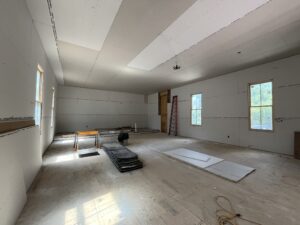
And finally, at Mount Zion Black Cultural Center in Athens, which is known to have a high water table, the constant rain made basement soil excavation a mud pit and caused the water table to rise. On the assumption that wet weather would only be more extreme in the future, HDC worked with the contractor Wolf Creek Contracting LLC to raise the level of the basement floor and enclosed all sump pits in waterproofed concrete enclosures. The basement will still be usable space, but design changes eliminate floor finishes and keep drywall a few inches off the floor behind the vinyl baseboard to minimize water damage in the future.
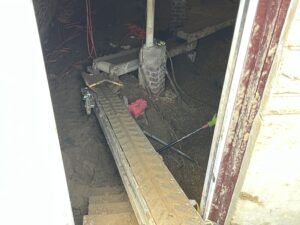
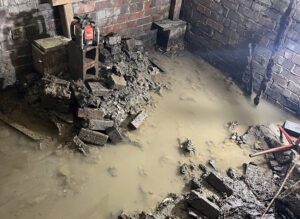
L: Wolf Creek Contracting rigged up a conveyor system to remove mud and bricks from the basement. R: Water in the basement after another heavy rain slowed construction progress.
Northcoast Behavioral Health Starts Construction
After multiple years on hold for funding and more, the renovation of the Northcoast Behavioral Health Dietary Building started in June! The general contractor is Feghali Brothers LLC out of Canfield, Ohio. Initial work consists of interior demolition to remove built-in freezers and coolers, asbestos abatement, quarry tile removal, and some exterior siding/fascia removal. The finished project will provide additional office space, including a meeting room and break room, and expand the existing restrooms to accommodate additional office workers. The expanded restrooms will be fully accessible and one of the office workers will finally stop sharing space with the server/IT closet!
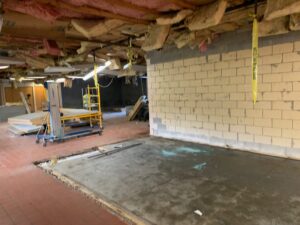
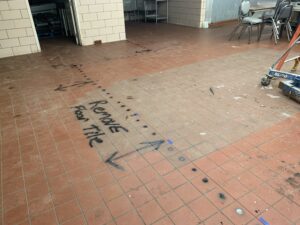
L: The floor under one of the removed coolers will be leveled and prepped to accept a new floor finish. R: Quarry tile marked for area to be removed.
Gallipolis Freight Station Museum
Kabil Associates is the lead firm on an ODOT-funded project to renovate a freight train into a meeting space for the Gallipolis Railroad Freight Station Museum. Hardlines Design Company is providing architectural and historic preservation consulting and Kramer Engineers is providing MEP services. The main architectural work is to finish the interior renovation of a passenger car to include an accessible restroom, catering kitchen, and a meeting room and to update the exterior painted finish. This passenger train once carried circus workers who lived in self-contained studios that had a kitchenette, bathroom, and fold-down bunk. One of the rooms is being converted into an accessible restroom and kitchen and the other will be restored back to its historic condition in the future. The project is expected to be bidding in late 2025!
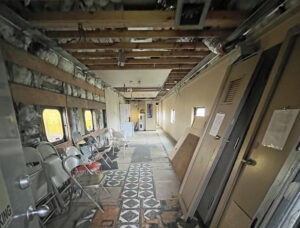
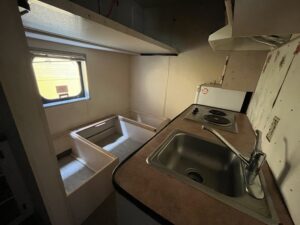
L: The interior of the passenger car has already been partially gutted. R: One of the intact studio “apartments.”
Carol Stewart Village Starts Construction!
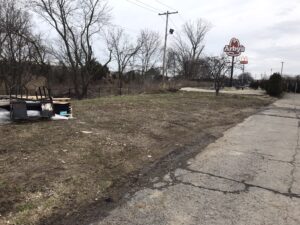
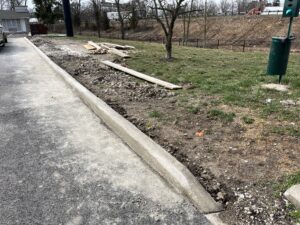
Left: View of west side looking north before construction. Right: View of west side looking south during construction with new curb and dog waste station.
HDC was commissioned by the City of Columbus to make improvements to Carol Stewart Village, a former 1980s hotel converted into housing for youths aged 18-24 who have aged out of the foster care system. Although the buildings had been renovated since the 1980s, the site around the building had not. HDC’s project includes the replacement of 70 packaged terminal air conditioners, or PTACs, ductless, self-contained air conditioning units that heat and cool small areas such as motel rooms and studio apartments. These units are also being anchored to prevent someone from breaking in from the outside. Sitework improvements include replacing crumbling concrete curbs and adding curbs where they do not exist now. The project also includes new dog waste disposal stations, which have already resulted in cleaner lawn areas. Another project repaved the parking lots. This project is just the beginning of improvements being made at Carol Stewart Village. Read about it in this Columbus Underground article.
Construction Opens up Macedonia Missionary Baptist Church for Additional Dendrochronology
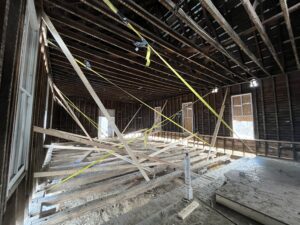
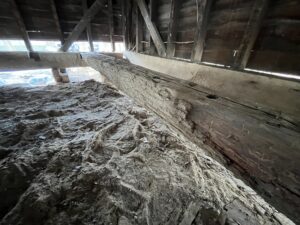
L: Overall view of interior looking SE. R: Detail of floor beam with bark still attached.
Dendrochronology is the scientific method of dating tree rings (also called growth rings) to the exact year they were formed in a tree. HDC had previously utilized the College of Wooster Tree Ring Lab in 2011 to date the logs used in the construction of the Deardurff House in Franklinton, Ohio. The house was known as the oldest structure in Franklin County still on its original foundation, built c. 1807. Dr. Greg Wiles took core samples in 2011 and determined that some of the logs were cut in 1798 and others in 1806, confirming the 1807 construction date, much to everyone’s relief! We suspect that the earlier logs were salvaged from the first shelter constructed by Abraham Deardurff and his teenage son before he went back to Pennsylvania to bring the rest of the family to Ohio.
Dr. Wiles came out to the Macedonia Church in the summer of 2024, but was unable to definitively date the logs since the ones he could reach were hewn and had lost their outermost rings. He asked to return when construction had started to see if better log candidates could be identified. Construction started in November 2024 and in December, the contractor, Mullins Construction found that termites had damaged the floorboards from below. The damaged floorboards were removed, exposing most of the original floor beams to view. Some of the floor logs still had bark, which makes them good candidates for dating. The Tree Ring Lab hopes to be on site this Spring to take samples from the wall and roof structure as well as the floor beams to get a complete picture of the building.
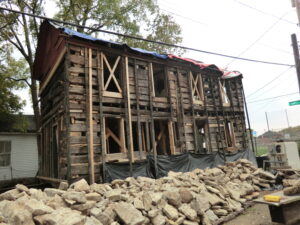
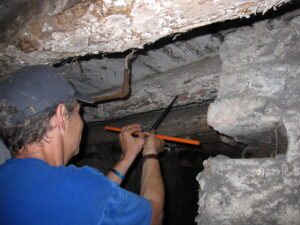
L: Front elevation of the Deardurff House after removal of wood siding exposed the underlying log structure. R: Dr. Greg Wiles taking a core sample in 2011.
HDC Dives into Working with 3D Scanning!
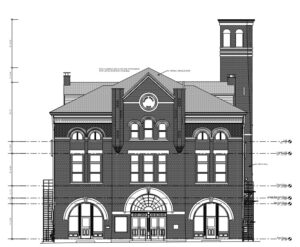
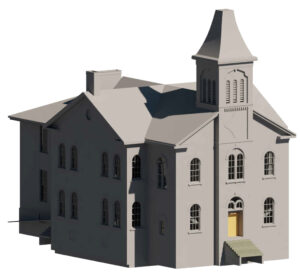
L: Elevation of Cedarville Opera House by Existing Conditions. R: Model of Clifton School by Truescan.
In 2006, The Kleingers Group, a civil engineering and surveying company headquartered in Cincinnati, conducted the construction surveying for our project at the Lincoln Theatre. After the project was completed, they came to our office to introduce a new service they had started on 3D scanning. After discussions on timelines and costs, we concluded that it was about the same cost to get a building scanned with drawings exported as it was for us to actually field measure and prepare the drawings. Field measuring in person also had the advantage in that we could also conduct a conditions assessment at the same time. However, it also poses a challenge if the building was very tall or not safe to measure in person.
This year, HDC opted for 3D scanning for the first time and worked with Truescan, who are the Kleingers team spun off on its own. The price was surprisingly affordable and the cloud model created by the scanning allows us to get dimensions for any part of the building without having to go out and measure it! It also offered efficiency as compared to typical field measuring. The scanner operator explained that the equipment has advanced quite a bit and what used to take 45 minutes to scan now takes 45 seconds. The equipment captures millions of pixels per second with 2 mm accuracy. HDC also utilized the company Existing Conditions to scan a different building at the same time.
Project Manager John Creasy Retires

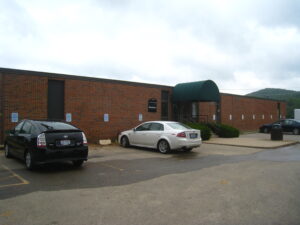
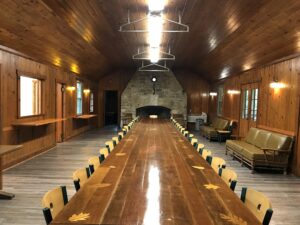
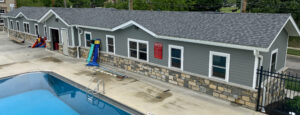
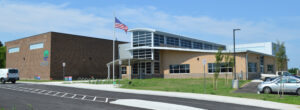 At left, the new Devon Pool Mechanical Building designed to match the Bath House and at right, the Scioto Southland Recreation Center with the renovated gymnasium left of the new entry and addition.