Ziti has been running in both AKC (American Kennel Club) and CPE (Canine Performance Events) agility trials. CPE has more “games” classes than AKC, and one that is particularly difficult for handlers (as least newbies like us) to figure out is Snooker. A Snooker course has 14 obstacles (jumps, tunnels, or 6 weave poles), but often one of the obstacles involves multiple jumps or tunnels, and you have 45 seconds to finish. The obstacles are labeled 2 through 7 and you get 2 points for taking obstacle #2, 3 points for obstacle #3, and so on. Then there are four red jumps worth 1 point each. You start with a red jump, followed by any numbered jump, and you do this three times, with a different red jump each time. After three red-number combinations, you run the numbered course in order, #2 to #7. If you knock one of the red jumps, you have to find another red jump to continue. If you knock two red jumps, you’re out. The team with the most points wins first place. The maximum points you can get is 51 by doing the #7 obstacle three times, but it can be tortuous to find a new red jump between each #7 obstacle. If there’s a tie in points, the team with the faster time wins.
To earn a C-ATCH title (CPE Agility Trial Champion) Ziti has to complete all lower levels and then complete all classes at Level 5, which means five each of Jumpers, Colors, Wildcard, Full House, Jackpot, and Snooker, along with 10 Standards. Ziti completed everything by 2025 except for the fifth Snooker. Charissa and Ziti ran a very conservative (minimal points) Snooker on January 17, 2026, and Ziti received plenty of meatball treats! Click here for a video of her successful run.
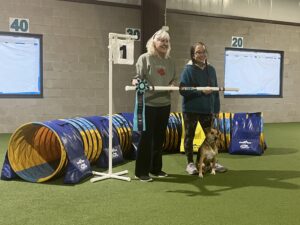
Left: Ziti smiles as she sails over a jump on the agility course. Right: Charissa and Ziti with judge June Ritchhart with rosette and memorial pole for her C-ATCH title.
Luis Andujar earned an undergraduate degree in Architecture from Miami University in Ohio and spent the next 25 years working on higher education, retail, medical, and multi-family projects for public and private clients. When Luis decided to change jobs, a former coworker of his who is also a former employee at HDC recommended that he send his resume here. We decided to hire him and he started at the end of July, just in time to take over projects when our intern Clara Reed left for graduate school at the University of Virginia – Alexandria in August. Luis will also take over come construction administration duties as we currently have a bunch of projects under construction!
In early August, the office took a field trip to visit the Cedarville Opera House and Clifton Opera House and eat a farewell lunch for Clara and a welcome lunch for Luis at the Clifton Inn.
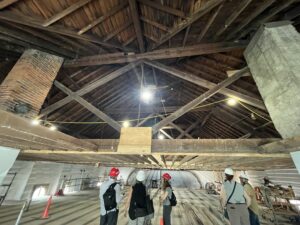
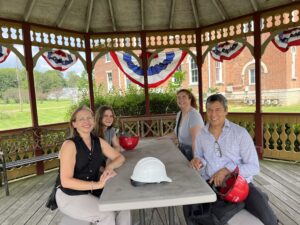
Left: HDC examining the incredible attic structure at the Cedarville Opera House. Right: Jennifer, Clara, Vivian, and Luis at the gazebo with the Clifton School in the background.
Clara Reed, an undergraduate student at the School of Architecture at The Ohio State University, worked at HDC in the summer of 2024, assisting with renderings for the Mount Zion Baptist Church renovation in Athens and preparing Revit construction drawings for the Ohio National Guard Tarlton Armory near Lancaster. In her final semester at OSU, Clara is working at HDC again, assisting with the Revit models for multiple renovation projects. We are also proud that Clara has been accepted into the graduate architecture programs at both the University of Cincinnati and the University of Virginia!
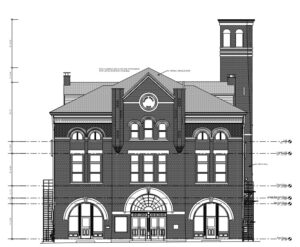
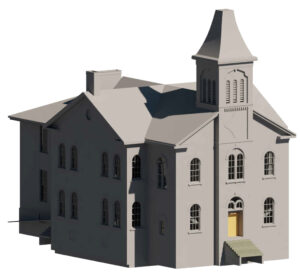
L: Elevation of Cedarville Opera House by Existing Conditions. R: Model of Clifton School by Truescan.
In 2006, The Kleingers Group, a civil engineering and surveying company headquartered in Cincinnati, conducted the construction surveying for our project at the Lincoln Theatre. After the project was completed, they came to our office to introduce a new service they had started on 3D scanning. After discussions on timelines and costs, we concluded that it was about the same cost to get a building scanned with drawings exported as it was for us to actually field measure and prepare the drawings. Field measuring in person also had the advantage in that we could also conduct a conditions assessment at the same time. However, it also poses a challenge if the building was very tall or not safe to measure in person.
This year, HDC opted for 3D scanning for the first time and worked with Truescan, who are the Kleingers team spun off on its own. The price was surprisingly affordable and the cloud model created by the scanning allows us to get dimensions for any part of the building without having to go out and measure it! It also offered efficiency as compared to typical field measuring. The scanner operator explained that the equipment has advanced quite a bit and what used to take 45 minutes to scan now takes 45 seconds. The equipment captures millions of pixels per second with 2 mm accuracy. HDC also utilized the company Existing Conditions to scan a different building at the same time.
John Creasy retired at the end of 2024 after working over 10 years at HDC. John grew up in Delaware County, Ohio, and earned a Bachelor of Architecture from the University of Florida in Gainesville. He worked at various architectural and engineering firms in central Ohio before landing at HDC just in time to spearhead the completion of the construction documents for the final phase of the Woodward Opera House rehabilitation and addition in Mount Vernon. He was project coordinator and construction administrator for renovation projects in Springfield, Ohio, and lead the construction administration of the Indian Mound (now Scioto Southland) Recreation Center renovation in Columbus. At the time of his retirement, John was working on wrapping up the lower-level renovation of the Beightler Armory for the Ohio National Guard and renovation of City of Columbus grant-funded projects at Carol Stewart Village and All THAT Teen Center. We wish John a long and relaxing life in retirement!
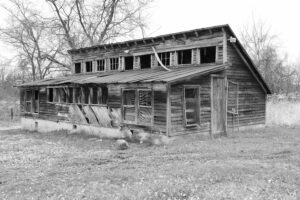
HDC is working with the City of New Albany to document the Chicken House at Taylor Farm since the building sits in the flood plain and may have to be moved or reconstructed at another location. The design for this half-monitor chicken house was invented by the University of Illinois Extension and became quite popular on rural properties in the Midwest throughout the 1920s. Since these buildings typically did not have electricity, the south-facing windows let in plenty of light to warm the nesting boxes used by the hens along the north wall in the winter. The high windows in the monitor draws hot air up and out for ventilating to keep the hens cool during the summer. The steep north roof causes cold north winds to blow over the building and there are no windows on the north wall. This building sits on a concrete foundation that features three square openings under the south-facing windows that allowed the chickens free access into the yard. The interior would have been divided into three individual rooms with removable walls for easy cleaning.
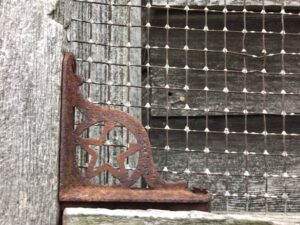
At left is an archival photograph of the southeast corner by Jeff Bates and at right is a cast iron corner brace at the screen door.
HDC first worked with Kramer Engineers at Hocking College in 2013 on a feasibility study to renovate a former bookstore building for the School of Music. The team is currently working on a new storage building for the Ohio Department of Natural Resources in Fernwood State Forest. In the intervening years, major projects together include the Scioto Southland Recreation Center, Devon Pool Bath House and Mechanical Building, administration buildings in Clark County, and the John Bryan State Park Day Lodge. The relationship has also worked in both directions with HDC working as Kramer’s consultant on their projects for the Department of Rehabilitation and Correction and Department of Developmental Disabilities.
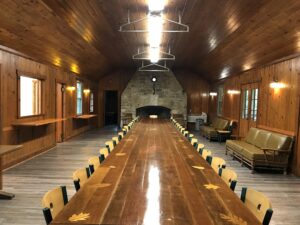
At left, the Hocking College Bookstore, which the team concluded was originally a modular building, and therefore not acoustically suited for a music school and at right, the interior of the John Bryan State Park day lodge, with built-in devices in the ceiling to lift the one-piece solid wood table.
At left, the new Devon Pool Mechanical Building designed to match the Bath House and at right, the Scioto Southland Recreation Center with the renovated gymnasium left of the new entry and addition.
Hardlines Design Company was named an Outstanding Diversity Organization by Columbus Business First. The eight organizations and 10 individuals will be honored at a happy hour reception on Thursday, April 6, at the Columbus Museum of Art and will be featured in Columbus Business First in their April 7, 2023, issue.
HDC President Charissa Durst presents at Circleville Rotary Club
After the article on Ohio’s historic theatres appeared in the Ohio AAAMagazine in November, HDC received a call from Bob Sneed to give a presentation on historic theatres to the Circleville Noon Rotary meeting in January.
Charissa Durst with Ian Webb, President of the Noon Rotary (left) and Bob Sneed (right).
Woodward Opera House featured in Revitalization Magazine
HDC’s opera house project appears in the Spring 2019 edition of Heritage Ohio’sRevitalization Magazine.
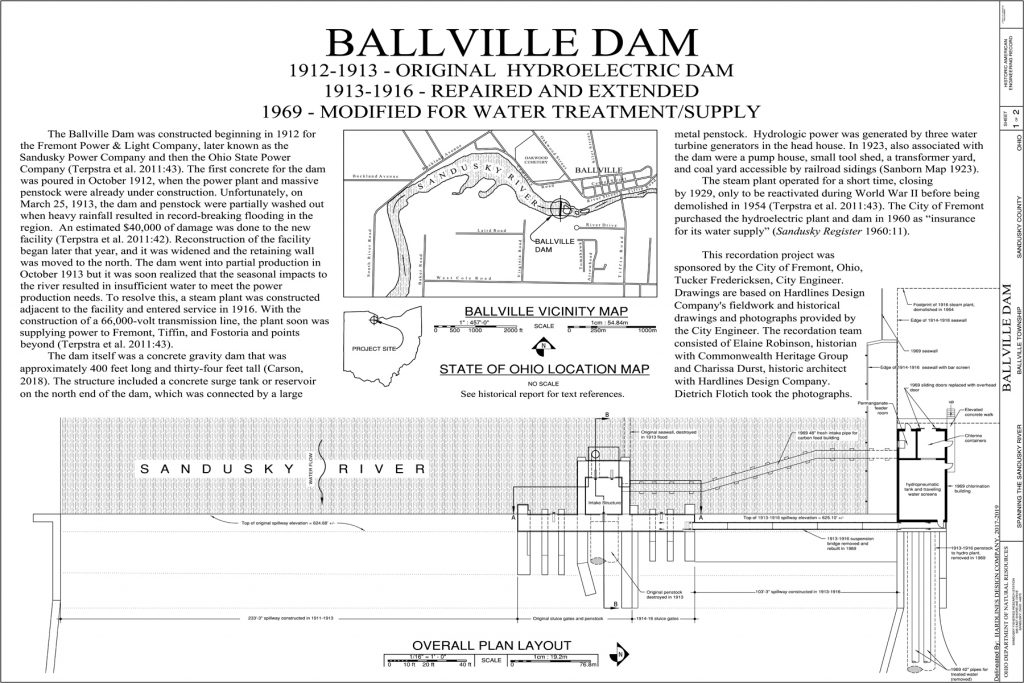
HDC completes drawings of the Ballville Dam
In 2017,
HDC was asked by Commonwealth Heritage Group to join their team to provide
Historic American Buildings Survey/Historic American Engineering Record (HABS/HAER)
documentation of the Ballville Dam on the Sandusky River, which was scheduled
to be demolished. After the team was awarded the project, HDC conducted
research at the city engineer’s office in Fremont, Ohio, and looked through
construction drawings, historical photographs, and inspection reports of the
dam. The team documented the dam prior to its demolition and during demolition
in the summer of 2018, and in the first quarter of 2019 completed the drawings
Construction
of the dam started in 1912 to provide hydroelectric power to the area, but the
Great Flood of 1913 almost destroyed the dam. The dam was rebuilt and expanded
in 1914-1916 with a steam plant added in 1916 to boost production needs. The
steam plant closed in 1929, was reactivated during World War II, and then was
demolished in 1954. The City of Fremont purchased the dam in 1960 to divert
fresh water for storage and renovated it in 1969 to treat fresh water. The City
constructed a new water treatment plant in 2013, and the Ohio Department of
Natural Resources made plans to remove the dam to allow the Sandusky River to
revert back to its natural state.
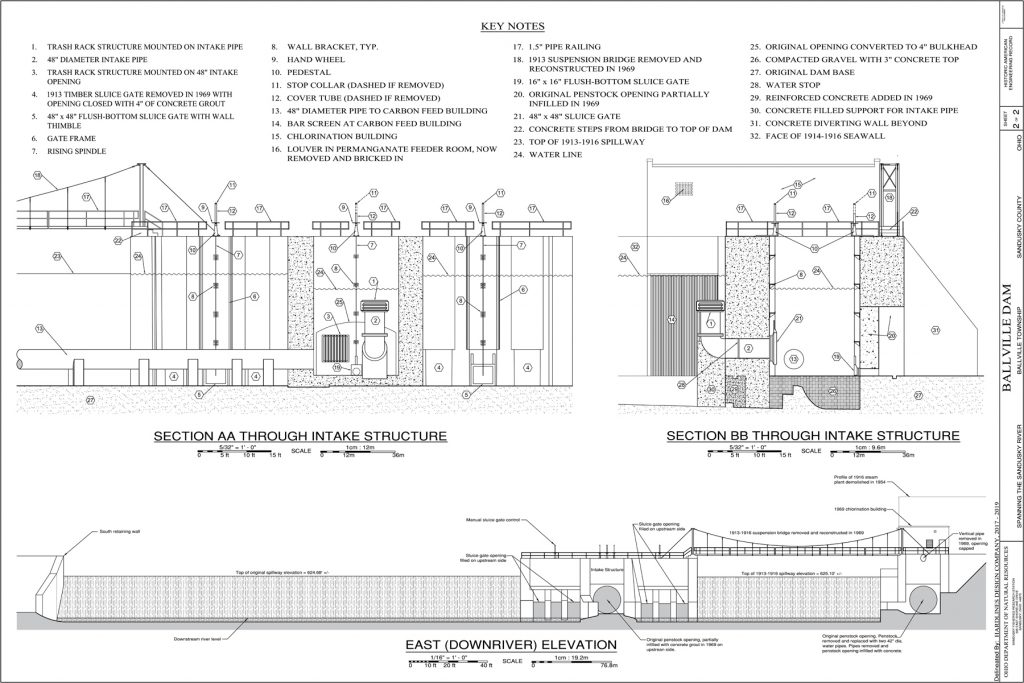
HDC historic architect Charissa Durst completed the drawings, Commonwealth Heritage Group historian Elaine Robinson wrote the background history, and Dietrich Floeter took the large-format photographs before and during the dam demolition.
Sheet 1 of 2, showing location map and overall plan.Sheet 2 of 2 showing elevation and details.
Devon Pool Bath House nears completion
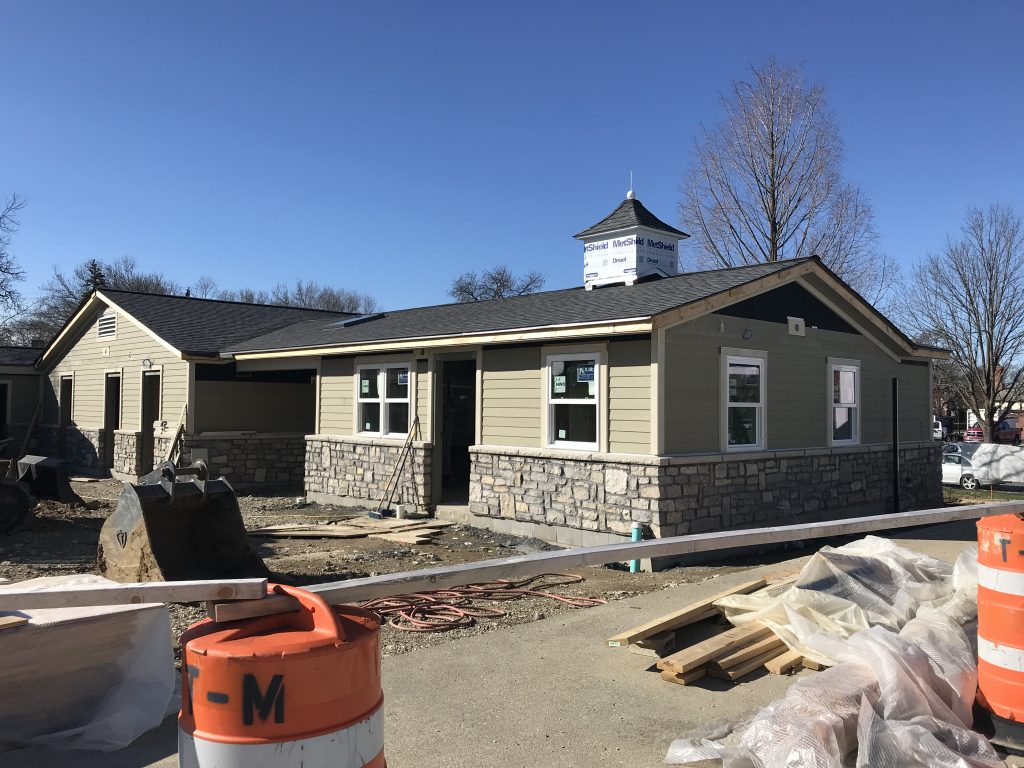
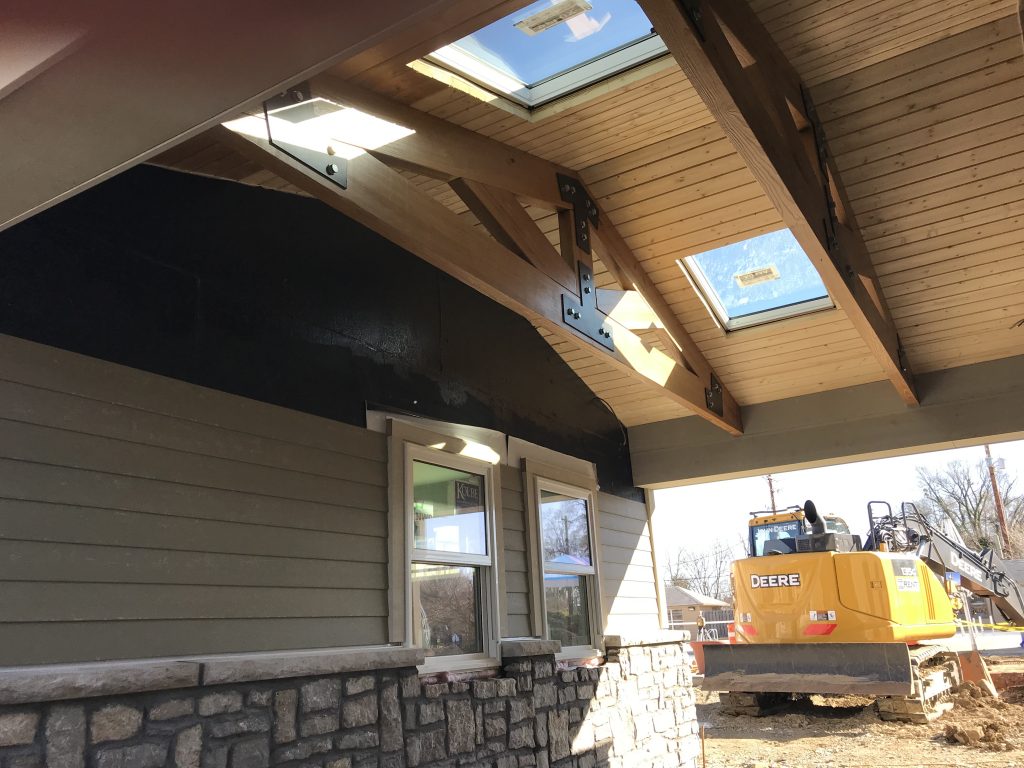
With a Memorial Day pool opening closing in fast, the work on the Devon Pool Bath House is nearing completion. All of the exterior walls and and the roof structure are up, and the remaining work consists of installing exterior wall and roof finishes and interior work. The wet weather delayed construction, but work is still expected to be completed in April with the pool scheduled to be open Memorial Day weekend. Some last-minute, change-order work included adding a manhole to access an unknown sanitary line tap and providing a new tap and pipe for a future pool equipment building, which HDC has also been commissioned to design.
The office section is ready for the cupola to be installedThe entry breezeway with decorative trusses and skylights
HDC starts work on Devon Pool Phase III
In January, HDC started work to design the final phase of improvements to Devon Pool. The project consists of replacing the two existing pool equipment buildings (one built in the 1930s and the other in the 1960s), replacing any pool equipment near the end if its life cycle, replacing the remaining old concrete deck, and making repairs to the toddler pool. The new equipment building will sit on the foundations of the existing buildings and enclose the space in between to create additional indoor storage space. Later this spring, the City of Upper Arlington will decide whether to retain the toddler pool as is, upgrade it to meet state health code, or replace it with a new amenity, such as a sprayground or splash pad.
Rendering of proposed street elevation of the mechanical equipment building.
OSU Cockins Hall Fourth Floor also nears completion
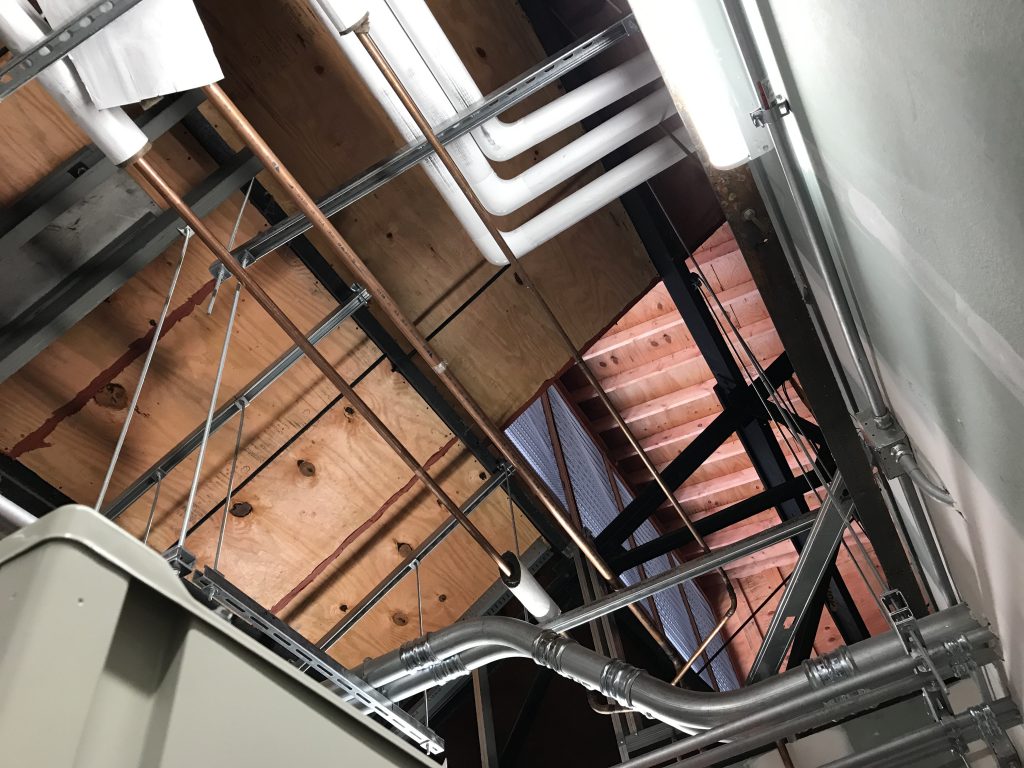
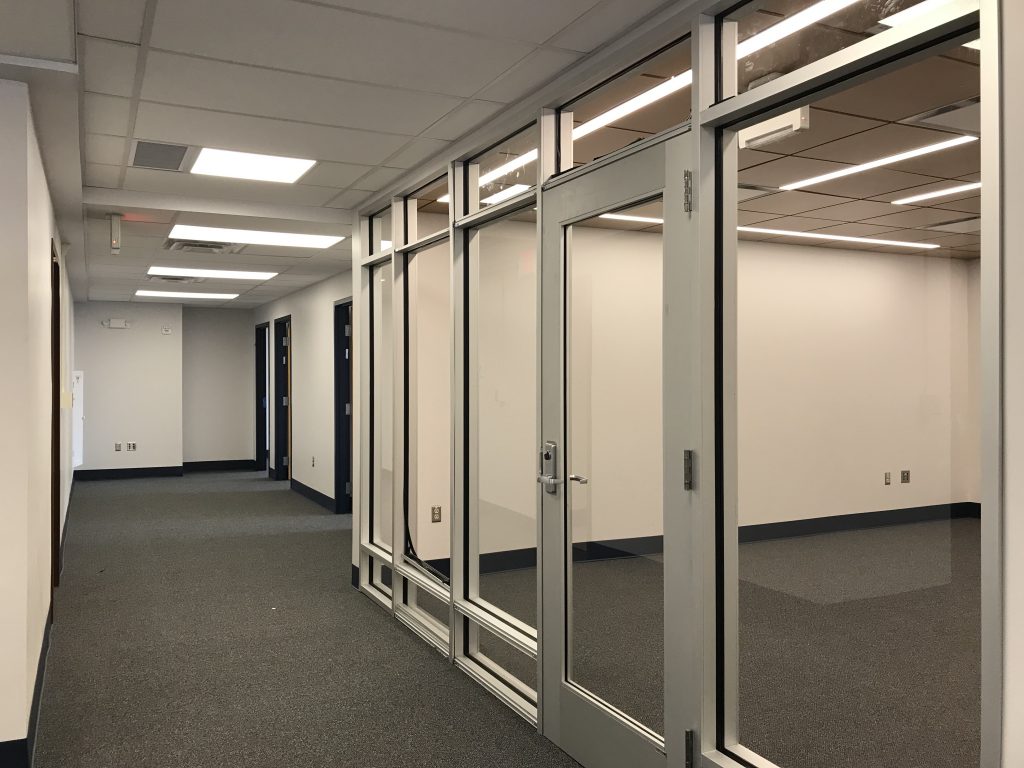
The renovation of the fourth floor in Cockins Hall at The Ohio State University for the Statistics Department reached substantial completion in March. The project started off as a fire alarm replacement project, but the scope expanded when OSU required the abatement of the asbestos-containing plaster ceiling between the fourth floor and the attic. OSU then required that the replacement ceiling not bear on any of the partition walls, to make future floor plan modifications possible without major construction. The Statistics Department then requested the renovation of the fourth floor to include a conference room named for a recent alumni donor. HDC was already working with Monks Engineers, a TEC company, on the fire alarm project and was tasked to lead the renovation work. This project consisted of alterations to the floor plan and new floor, ceiling and wall finishes along with the named conference room. During design, the existing 40-year-old air handling unit in the attic failed, and replacement of the HVAC system for this floor was added to the project, requiring alterations to an attic dormer and a new attic plenum to bring in sufficient outside air. Construction is scheduled to be completed by May to allow the Statistics Department to move back in over summer break.
This attic dormer was altered to provide fresh air to the new HVAC system.The entry to the new conference room is waiting for the art glass installation.
Retrospective of HDC’s office beagles
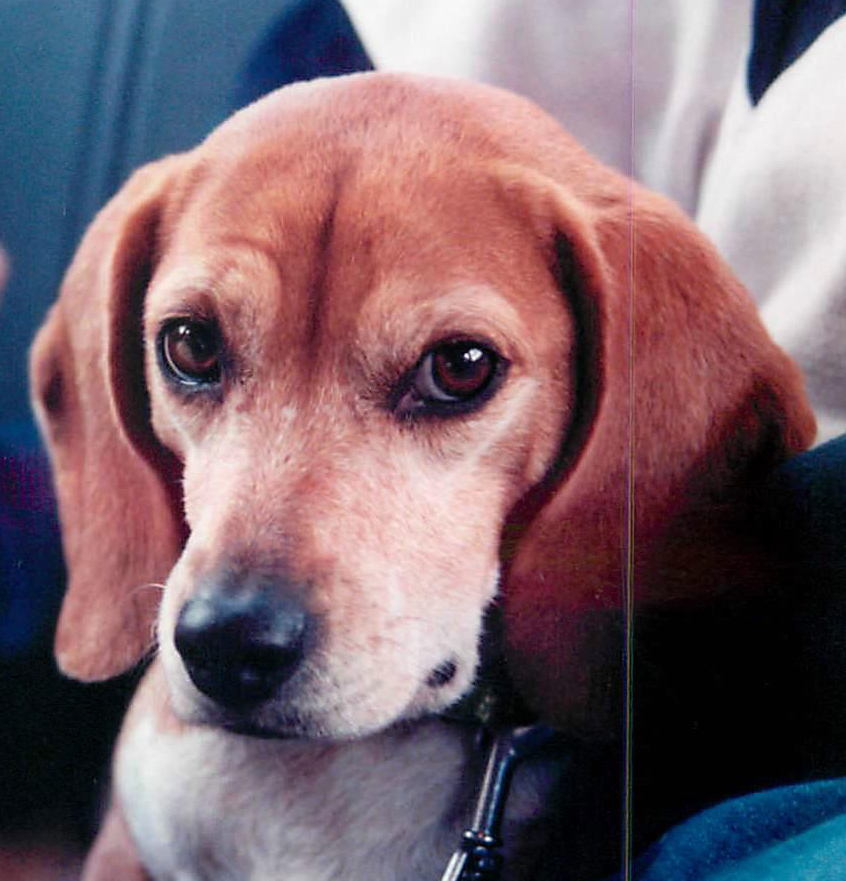
The first office dog at Hardlines Design Company was Bagle the Beagle. Bagle came from the Delaware County Humane Society and of the six dogs available for adoption that day in 1993, she was the only one who didn’t bark. Bagle had previously been adopted but was returned because she was too afraid of the family’s son, and the shelter thought her original owner probably included males who beat her. Bagle was about a year old when she joined HDC, and it soon became evident that she was an alpha dog who loved to track rabbits.
Bagle the Beagle in 1997. She managed the office from 1993 to 2004.
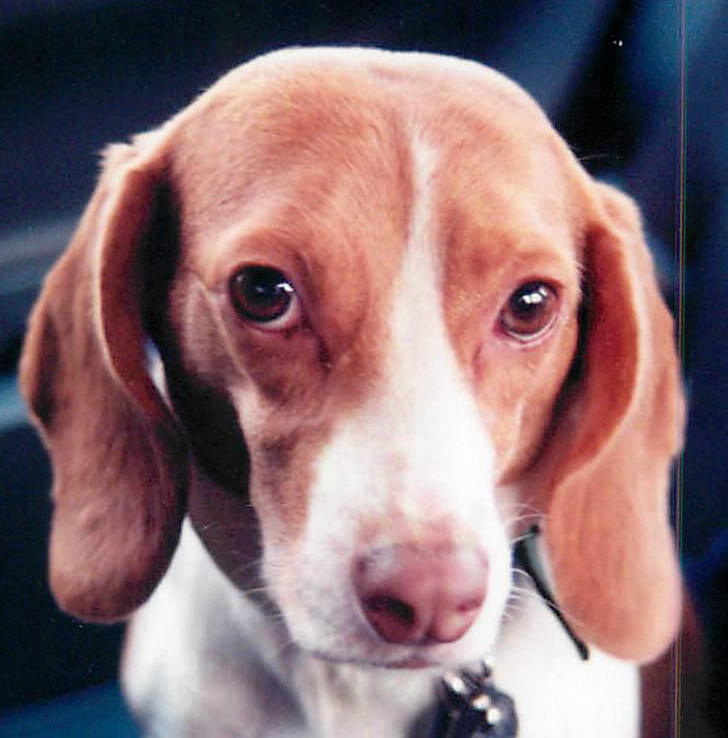
At the end of 1996, a client in Athens, Ohio, who knew we had a beagle kept calling to see if we wanted to adopt a second beagle that was at Athens Pound Rescue. Sadie the Beagle came to the office over Christmas break and tried soooo hard to be Bagle’s best friend, but Bagle was not having any of it. As the alpha dog, Bagle expected Sadie to acknowledge her lead and do what she was told. I think Bagle expected this of the humans as well! Over the next few months, it was evident that Bagle was very unhappy at not being the only dog anymore, and she started limping and dragging her rear leg. Don’s mother’s daschund had died the previous year, so Don’s thought was to train Sadie to be a replacement dog for his mother. The Monday after Don took Sadie to Akron for the weekend, Bagle’s limp was cured and HDC’s employees were amazed at the spring in her step and the shine in her eyes, which they had never seen before. Bagle was perfectly happy to host Sadie for visits, as long as Sadie went home afterwards.
Sadie the Beagle in 1997. She visited the office from 1997 to 2006.
Bagle
died of a heart attack in April 2004 at just over 12 years of age, probably as
a result of chemotherapy for the thyroid cancer that was diagnosed in February
2004. Donut came from the Franklin County Dog Shelter in May 2004 as a wild eight-week
old puppy who had been found on the street when she was four weeks old.
However, she was so cute we spent the first year in weekly puppy training
classes, trying to get her domesticated. Sadie actually came to the office for
a visit and met Donut as a puppy, but you could tell Sadie was expecting to see
Bagle. Just before she turned 12 in 2006, Sadie left us after developing a
fast-growing stomach cancer.
Unlike Bagle, Donut had no concept of how to track rabbits. Donut’s DNA test indicated that she was 10-20 percent rat terrier, and I think the terrier portion was all in her brain. Donut loved to chase chipmunks and catch mice and play with them by tossing them in the air, which apparently is what rat terriers do. We said goodbye to Donut in December 2018 after her kidneys started to fail when she was almost 15.
Donut the Beagle in 2006. Donut’s reign lasted from 2004 to 2018.
Who
will be the next HDC office beagle? That still remains to be seen, but it will
likely be a puppy since Donut was the only beagle who was able to be trained to
(mostly) come when called off leash. Stay tuned for updates!



 At left is an archival photograph of the southeast corner by Jeff Bates and at right is a cast iron corner brace at the screen door.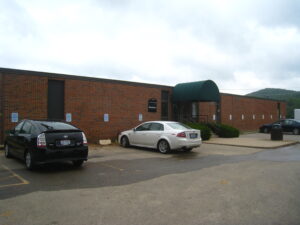
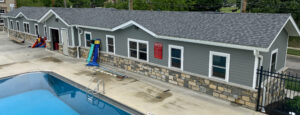
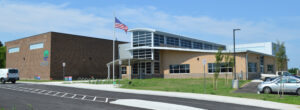 At left, the new Devon Pool Mechanical Building designed to match the Bath House and at right, the Scioto Southland Recreation Center with the renovated gymnasium left of the new entry and addition.



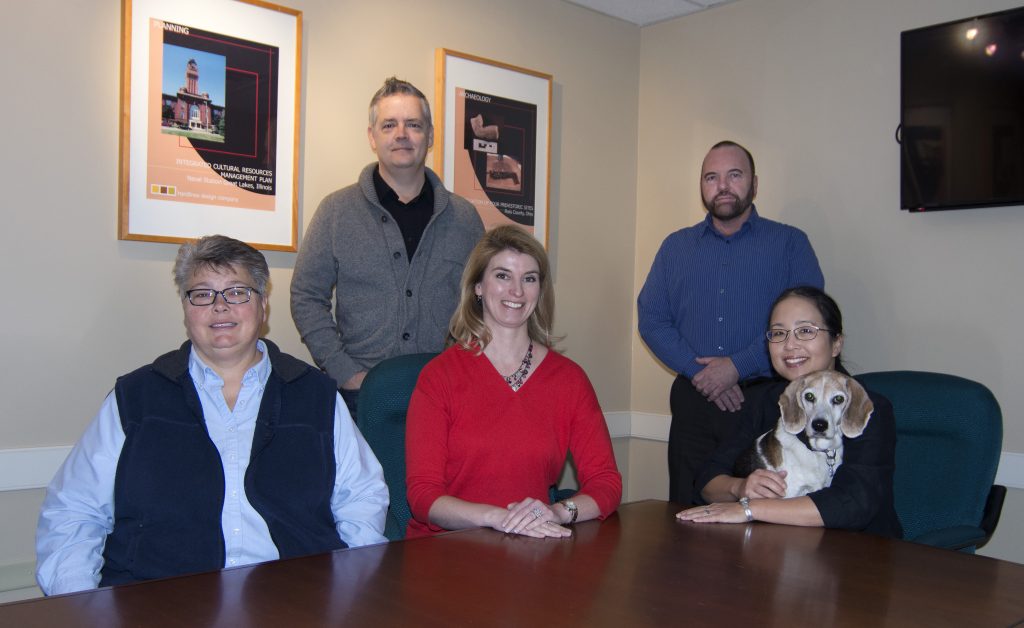
 Charissa’s beagle Donut, in 2017
 Brad’s buddy Baxter, dressed up in 2016
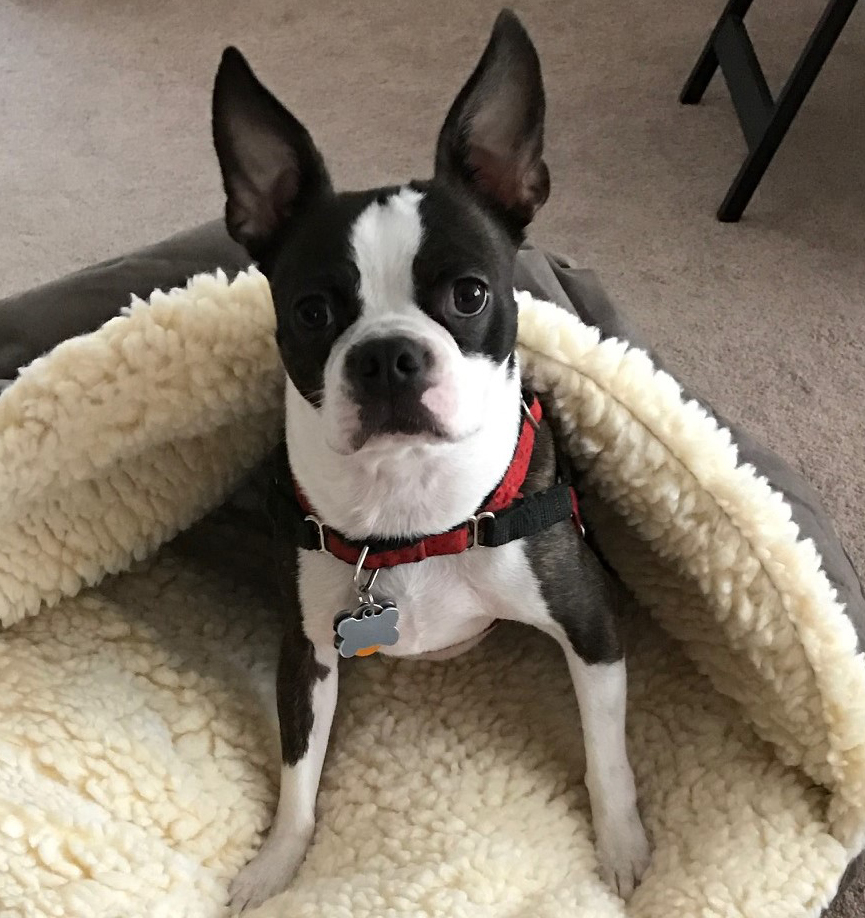 Megan’s baby Sherlock, in 2017
 Cathie’s 14 years old Casey, in 2017