Category Archives: Historic Preservation

Advancing Preservation in Licking County

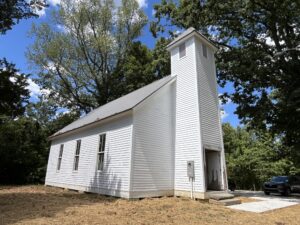
Hardlines partnered with the Licking County Historical Society in 2025 to bring new momentum to treasured Newark landmark, the Buckingham Meeting House. The 1835 building now houses the Society’s Library & Archives and serves as a banquet facility. HDC’s detailed cost estimate to guide improvements helped secure a $250,000 state grant. HDC is now serving as criteria architect, alongside Karpinski Engineering as the criteria MEP engineer, to prepare documents for a design-build team to be selected later this year.
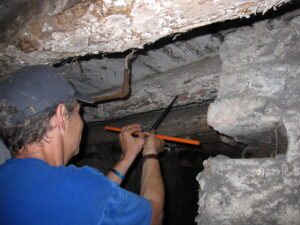
Buckingham Meeting House during initial fieldwork in February 2025
HDC has a decades-long legacy of preservation work in Licking County. In the late 1990s, the firm helped save and transform the Davis-Shai House in Heath. HDC’s feasibility study for the relocated historic home helped secure a $500,000 state capital grant to rehabilitate the structure into a community center. HDC also supported the Licking County Historical Society with a Conservation Assessment Program (CAP) survey of the 1828 Sherwood Davidson House in Newark.
 
Left: Davis-Shai House after rehabilitation in 2000; Right: Sherwood Davidson House  during fieldwork in 1998
In 1998-1999, HDC completed ADA improvements to a group home in Newark for the Ohio Department of Developmental Disabilities (now Ohio Department of Behavioral Health) and Newark Resident Homes. The project consisted of dividing a large room on the first floor into an accessible bedroom and bathroom along with adding a wheelchair ramp to the first floor. The original plan was for a simple ramp from the rear parking lot to a new door in the dining room bay window. The facilities manager did not like the idea of giving up the bay window and also noted that many residents were picked up at the front door, not the parking lot. HDC design a new ramp to a new deck at the front door with a seating area at the ramp landing.
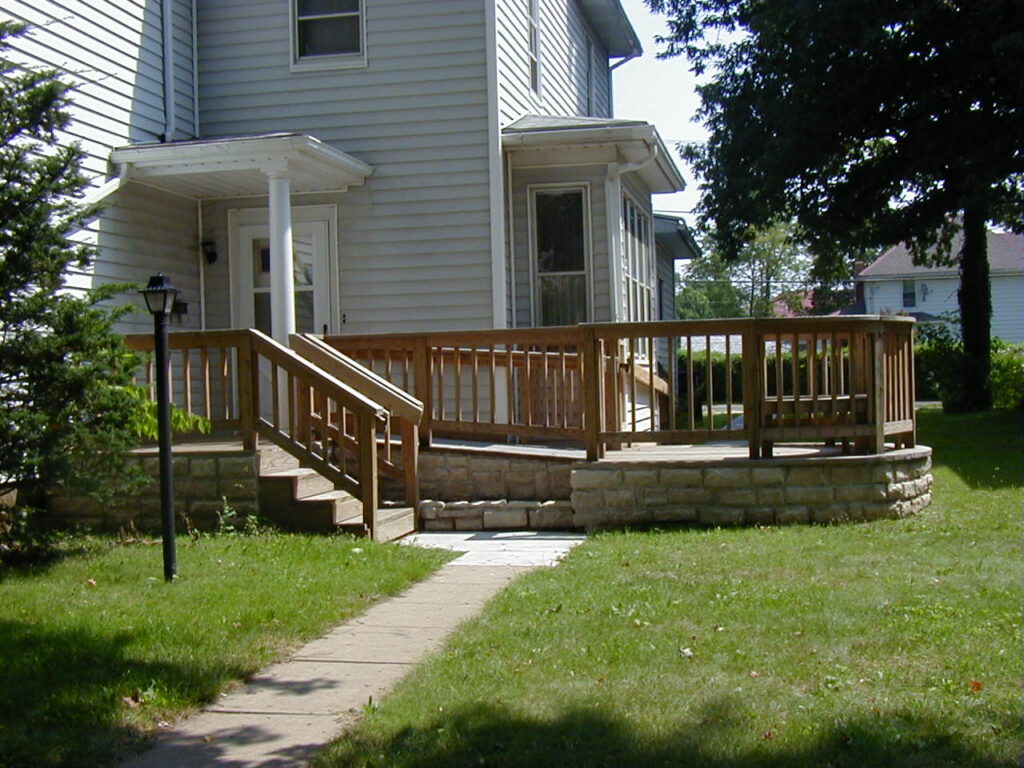
New ramp and deck in 1999
Beyond historic buildings, HDC has completed archaeological surveys across Licking County, beginning with its first Ohio Department of Transportation cultural resources project in 1998. More recently, HDC prepared a feasibility study for the Robbins Hunter Museum, an 1842 historic home reflecting generations of local history and philanthropy. From preservation planning to accessibility and archaeology, HDC’s work in Licking County demonstrates a sustained commitment to honoring the past while building a stronger future.

Side entrance to the Robbins Hunter Museum with clock tower where a bust of Victoria Woodhull that appears on the balcony on the hour


Zanesville Historical Marker Moves Forward

HDC was successful in getting the Downtown Zanesville Historic District listed in the National Register of Historic Places in 2024, but one final piece of mitigation remained outstanding: the Ohio historical marker. Ohio historical markers started in the 1950s, born from the 1953 state sesquicentennial, to document important people, places, and events, with the first marker placed in 1957 for Akron’s Portage Path, all managed by the Ohio History Connection (formerly the Ohio Historical Society) to tell community stories through Ohio-shaped signs. The program, run on an annual cycle with sponsor-funded markers, now boasts over 1,700 markers, including special ones for the Bicentennial and LGBTQ+ history, making Ohio’s past accessible.
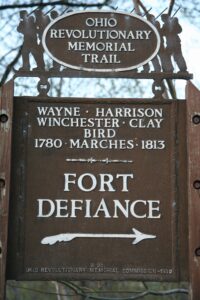
The company that produced the first historical marker is still producing them today. In 1927, E. M. Hawes founded Sewah Studios (his name spelled backwards) in Marietta, Ohio, to create roadside signs and markers for automobile tourists. Hawes researched and developed a cast aluminum process that was lightweight, inexpensive, and corrosion resistant compared to traditional wood, bronze, or ferrous metal signs common at the time. He also sponsored a cash competition where hand lettering artists submitted designs for capital and lower case letters less than 1 inch in size, which did not exist at the time. Hawes chose a winner, made a few changes, and the Sewah script was born. Sewah’s first commission was for over 500 signs for the Ohio Revolutionary Trail Commission in 1929.
One of the original Ohio Revolutionary Trail markers, shot by Dale K. Benington, on April 6, 2010.
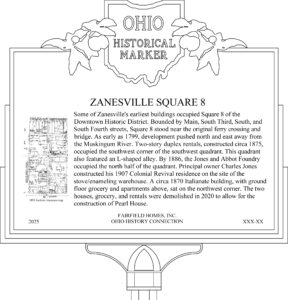
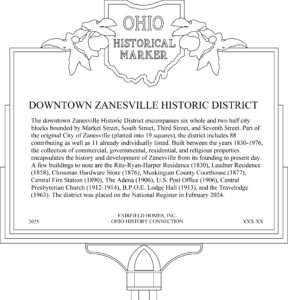
The distinctive Ohio-shaped marker was designed by Sewah Studios, who submitted the winning design to the historical marker committee in 1955. They received the contract to cast the first historical marker in Akron and have been producing them ever since. The process consists of hand assembling the letters and images into a pattern, which is then pressed into fine sane to create a mold. Two halves of the sand mold are then clamped together and molten aluminum is poured into the cavity. The raw casting is then sent to the finishing department who adds the colors to the sign.
The Ohio History Connection’s marker approval process simply involves approving text not to exceed a specific word count and images of a specific size. However, the City of Zanesville required graphics showing exactly what the sign would look like, so HDC traced the outline of a historical marker in AutoCAD and mocked up the text and image for both the Zoning and Building permits, which were received in November 2025. The marker application was signed soon after and we are waiting on a proposed delivery date.
     
Proposed historical marker Side A and Side B.

Macedonia Missionary Baptist Church Celebrates Jubilee Opening

The Macedonia Missionary Baptist Church received its occupancy permit on November 12, 2025, just in time for the jubilee celebrating its re-opening! Click here for an article and additional photographs of the opening in the Ironton Tribune.

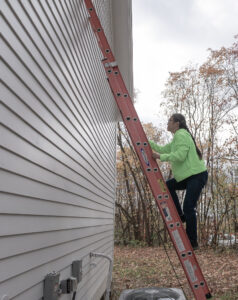
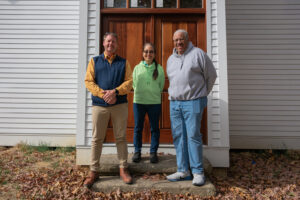
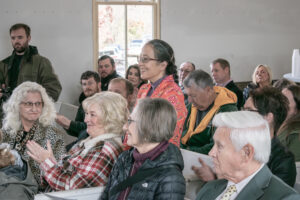
Left: Charissa Durst climbing into the attic during the final punch inspection on 11/7/2025. Center: Contractor Dan Mullins (left) and project manager Lacy Ward (right) with Charissa Durst on the church stoop after the punchlist. Right: Charissa Durst standing at the Jubilee celebration.  All photos by Jason Lucas.

Mount Zion Black Cultural Center Phase 1 Nears Completion

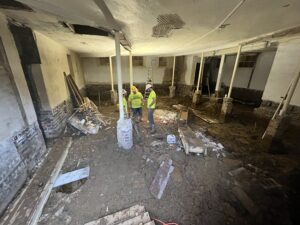
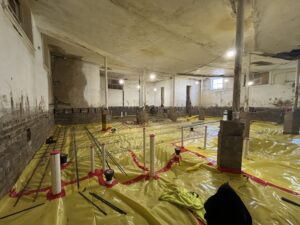
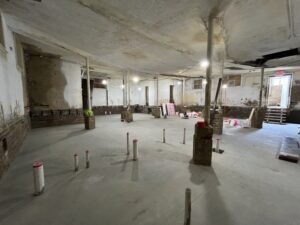
After a very wet spring and early summer, dry weather in late summer allowed Wolf Creek Construction to complete most of the exterior excavation and waterproofing, start the elevator addition, and pour the main basement floor slab. The floor is an 8” thick mat slab with 12” thick areas under future column locations. The floor is also heavily reinforced and attached to the exterior walls so rising water will not be able to dislodge it. One of the workers commented we could park an airplane in the basement! Wolf Creek Construction has also been awarded Phase 2 to rehabilitate the rest of the building, which will start once Phase 1 is closed out.
   
Left: View of the mud pit in the basement in April. Center: Rebar and vapor barrier being laid in preparation for the new concrete floor slab. Right: The new basement floor in September.

Ohio’s First Black Church Nearing Renovation Completion

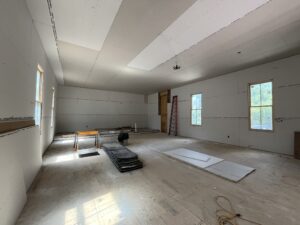
The Macedonia Missionary Baptist Church in South Point had some state grant money redirected to another project, so some items not essential to the occupancy permit had to be postponed. These included items such as the new wood floor, installing the original tin ceiling and the replacement pieces, new window and door casings, reinstalling the wood wall base, and interior painting. The exterior painted wood handicap ramp has also been swapped for a premanufactured aluminum ramp. The owners are hoping to raise enough private funds to finish the remaining work this year.
      
Left: View of the northeast corner of the church, which is still awaiting delivery of the new custom front doors. Right: Interior looking northwest toward the location of the new egress door, which will lead to the wheelchair ramp.

What Do We Do With All This Water?

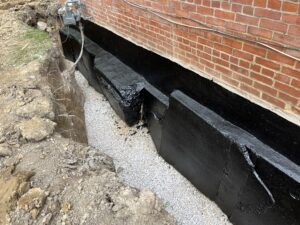
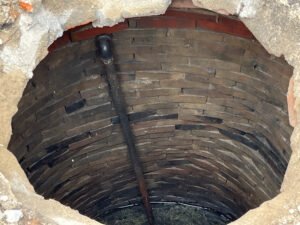
When Intel decided to build a plant in Ohio, one of the reasons is the abundance of water. Apparently, data centers keep getting built here for the same reason. But it you are working on an old building with a basement, all that water can be a liability! At The Gardner House, Steller Construction finished installing the underpinning, new concrete slab floor, and exterior perimeter drain when a torrential downpour saturated the site. Rain came down so fast that the drainage system couldn’t get water out fast enough to prevent it from entering the basement. One solution is to add a drainage mat on top of the waterproofing to keep water off the exterior wall and direct it down to the drain pipe.
     
L: New fluid-applied waterproofing membrane that will be augmented with a drainage mat against the wall. R: An exiting cistern filled with water that we hope can be made into a historical exhibit that the pubic can view.
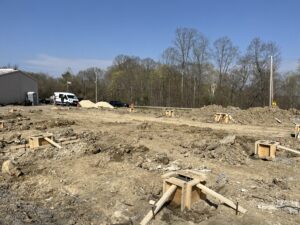
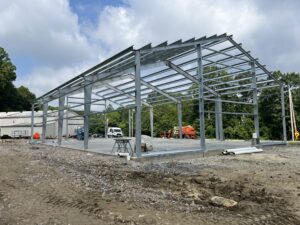
At Fernwood State Forest, the foundation drilling team working with E. Mullins Construction hit water that required the use of steel caissons to stabilize the shafts walls before the concrete could be poured. As an option, the driller could have eliminated caissons and used a slurry product known as “construction mud” (amongst other colorful names) in the shafts to keep the walls stable as concrete was being poured.
     
L: The Fernwood State Forest storage building in April 2025 with concrete piers curing in wood formwork. R: In July 2025, the floor slab in place and building framing up and anchored to pier foundations.
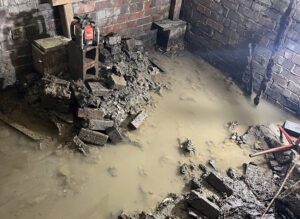
And finally, at Mount Zion Black Cultural Center in Athens, which is known to have a high water table, the constant rain made basement soil excavation a mud pit and caused the water table to rise. On the assumption that wet weather would only be more extreme in the future, HDC worked with the contractor Wolf Creek Contracting LLC  to raise the level of the basement floor and enclosed all sump pits in waterproofed concrete enclosures. The basement will still be usable space, but design changes eliminate floor finishes and keep drywall a few inches off the floor behind the vinyl baseboard to minimize water damage in the future.
     
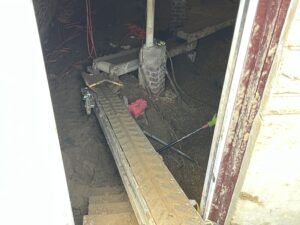
L: Wolf Creek Contracting rigged up a conveyor system to remove mud and bricks from the basement. R: Water in the basement after another heavy rain slowed construction progress.

Gallipolis Freight Station Museum

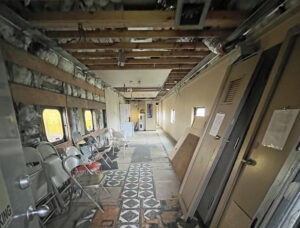
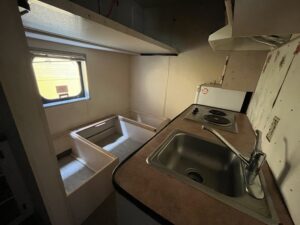
Kabil Associates is the lead firm on an ODOT-funded project to renovate a freight train into a meeting space for the Gallipolis Railroad Freight Station Museum. Hardlines Design Company is providing architectural and historic preservation consulting and Kramer Engineers is providing MEP services. The main architectural work is to finish the interior renovation of a passenger car to include an accessible restroom, catering kitchen, and a meeting room and to update the exterior painted finish. This passenger train once carried circus workers who lived in self-contained studios that had a kitchenette, bathroom, and fold-down bunk. One of the rooms is being converted into an accessible restroom and kitchen and the other will be restored back to its historic condition in the future. The project is expected to be bidding in late 2025!

     
L: The interior of the passenger car has already been partially gutted. R: One of the intact studio “apartments.”

3D Drone Photographs Assist with Exterior Envelope Repairs

     
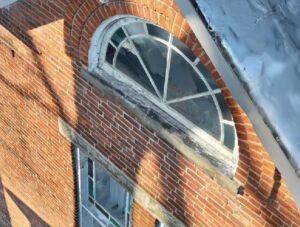
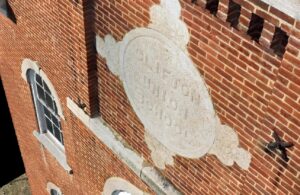
Left: Detail of attic dormer at the Clifton Opera House. Right: Detail of Sign Plaque at Clifton School.
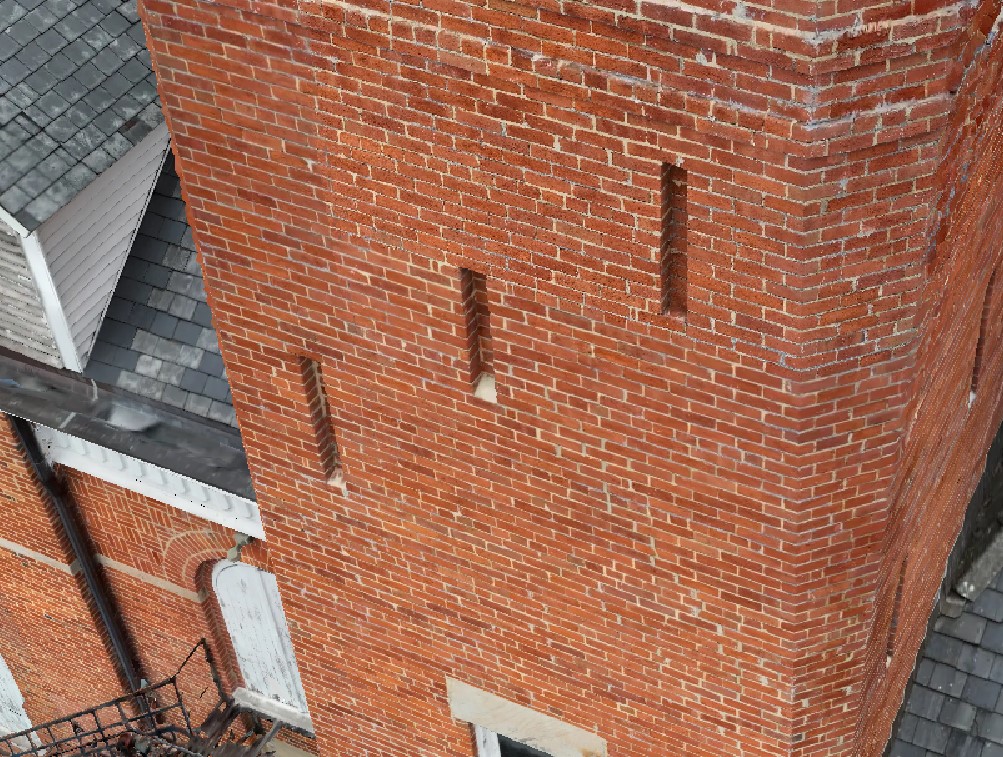
HDC has been working on preparing construction packages to rehabilitate the historic Cedarville Opera House in Cedarville and the historic Clifton Opera House and Clifton School in nearby Clifton. All three buildings were constructed in the late 19th century and have varying degrees of roof, brick wall, and wood window deterioration. HDC commissioned MAJ Consulting LLC to take high resolution photos of the exterior of each building and stitch the photos together into a high-resolution 3D exterior model of the building that is so clear we can conduct an exterior assessment and prepare remediation drawings based on the model alone! This method is extremely helpful for steeply sloped roofs and tall buildings where exterior conditions had to be observed and assessed from the ground.

Detail of Fire Department Hose Tower at the Cedarville Opera House.


HDC Remembers Cathie (Chris) Senter 1966-2023

The historic preservation community was shocked to hear of the sudden passing of Cathie Senter on February 27, 2023, of a heart attack. Cathie started her career in Canton, Ohio, where her passion for historic preservation earned her multiple awards, including Stark County Citizen of the Year. Cathie first interviewed for a job at HDC in 2007 but ultimately decided to go back to school. Before she started school, she worked at HDC over the summer on the window package for the Woodward Opera House and helping to finishing the HAER drawings for Monongahela River Locks and Dam project for the U.S. Army Corps of Engineers Pittsburgh District. After getting a degree from Belmont Technical College, she stayed to become a beloved instructor of the preservation trades, including doors and windows, model and mold making, plaster, roofing and flooring, and all types of historic masonry. Cathie came back to work for HDC in 2017 and endeared herself to preservation clients, who appreciated her knowledge and willingness to explain proposed solutions. She conducted assessments and prepared reports for the St. Louis Arsenal, caretaker lodges and chapels at national Veterans cemeteries, and was working to complete the final phase of the rehabilitation of the Historic Gardner Homestead. Her attention to details and desire to take care of her clients often led to extended schedules, but her premature passing is one deadline we gladly would have postponed.
Cathie (Chris) at work at HDC.
    
At left, a 2007 drawing from the Monongahela Lock and Dam documentation project and at right, the restored windows at the Woodward Opera House in  Mount Vernon.