Category Archives: Hardlines Design Company

Ziti the Noodle Dog Continues to Recover from Back Surgery

We continue to be incredibly thankful that Ziti is still healthy and active after her surgery almost 2 years ago. In the last few months, the cooler weather seems to have made Ziti even more wound up than usual that even a weekend of agility trials plus agility class once a week can’t seem to dissipate. Ziti ran in the 2025 AKC FastCAT Invitational in October, where she also passed her Fetch Intermediate test, and then ran her fastest time in White Post, Virginia. In her spare time Ziti goes to the park. If you would like a copy of Ziti’s 2026 calendar, click here.
      Left: Her expression says it all in this Mark Baer photo from the Invitational – Ziti loves to run! Right: Ziti posing by a colorful tree in Harper’s Ferry National Historical Park.

Progress Continues at Northcoast Behavioral Health Dietary Building

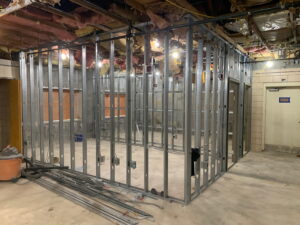
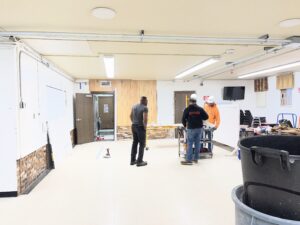
The project recently expanded to include replacement of the existing restroom fixtures and partitions, which everyone thought would look very dated when seen next to the renovated office area around it. After demolition was completed in the kitchen areas, work started on framing the new office walls for the new office suite. This included updating the existing window wall while retaining the existing wheelchair ramp, which provides accessible entry to restrooms for workers in the maintenance building in the rear. Construction is anticipated to be completed in Fall 2026.
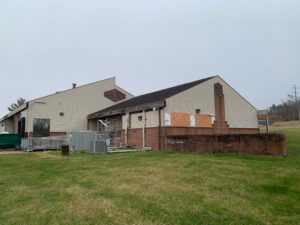
      Left: Exterior windows and wall being updated. Right: Framing for new offices where the two windows are being updated.

All THAT Teen Center Construction Starts Up Again

After the roof replacement, construction at the All THAT Teen Center went on hold as discussions took place with the City building department on whether the project needed a site compliance plan review. Finally, the building department agreed that since there was an ownership change and not a use change (building was still leased by a church for Sunday services), a site compliance plan was not required. However, since the classrooms were used for after school activities and not Sunday school activities, the examiner required that each classroom have an individual smoke detector in addition to the fire alarm system and rated corridor doors already in the project. After the updated fire alarm plans were approved, construction could finally start on the last phase of the project, which is now scheduled to be completed in January 2026.
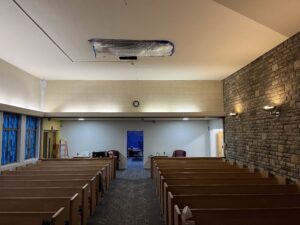
   
Left: New classroom walls going up at rear of sanctuary. Center: New restroom partitions in lower level. Right: Multi Purpose Room renovations underway.

Zanesville Historical Marker Moves Forward

HDC was successful in getting the Downtown Zanesville Historic District listed in the National Register of Historic Places in 2024, but one final piece of mitigation remained outstanding: the Ohio historical marker. Ohio historical markers started in the 1950s, born from the 1953 state sesquicentennial, to document important people, places, and events, with the first marker placed in 1957 for Akron’s Portage Path, all managed by the Ohio History Connection (formerly the Ohio Historical Society) to tell community stories through Ohio-shaped signs. The program, run on an annual cycle with sponsor-funded markers, now boasts over 1,700 markers, including special ones for the Bicentennial and LGBTQ+ history, making Ohio’s past accessible.
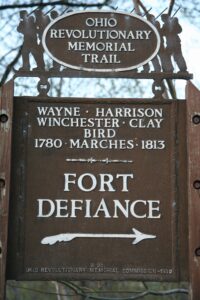
The company that produced the first historical marker is still producing them today. In 1927, E. M. Hawes founded Sewah Studios (his name spelled backwards) in Marietta, Ohio, to create roadside signs and markers for automobile tourists. Hawes researched and developed a cast aluminum process that was lightweight, inexpensive, and corrosion resistant compared to traditional wood, bronze, or ferrous metal signs common at the time. He also sponsored a cash competition where hand lettering artists submitted designs for capital and lower case letters less than 1 inch in size, which did not exist at the time. Hawes chose a winner, made a few changes, and the Sewah script was born. Sewah’s first commission was for over 500 signs for the Ohio Revolutionary Trail Commission in 1929.
One of the original Ohio Revolutionary Trail markers, shot by Dale K. Benington, on April 6, 2010.
The distinctive Ohio-shaped marker was designed by Sewah Studios, who submitted the winning design to the historical marker committee in 1955. They received the contract to cast the first historical marker in Akron and have been producing them ever since. The process consists of hand assembling the letters and images into a pattern, which is then pressed into fine sane to create a mold. Two halves of the sand mold are then clamped together and molten aluminum is poured into the cavity. The raw casting is then sent to the finishing department who adds the colors to the sign.
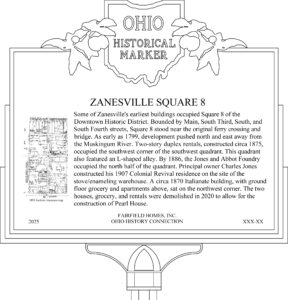
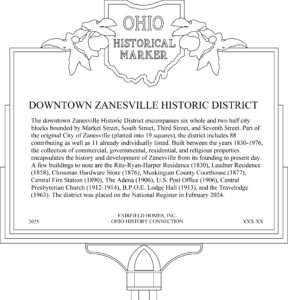
The Ohio History Connection’s marker approval process simply involves approving text not to exceed a specific word count and images of a specific size. However, the City of Zanesville required graphics showing exactly what the sign would look like, so HDC traced the outline of a historical marker in AutoCAD and mocked up the text and image for both the Zoning and Building permits, which were received in November 2025. The marker application was signed soon after and we are waiting on a proposed delivery date.
     
Proposed historical marker Side A and Side B.

Macedonia Missionary Baptist Church Celebrates Jubilee Opening

The Macedonia Missionary Baptist Church received its occupancy permit on November 12, 2025, just in time for the jubilee celebrating its re-opening! Click here for an article and additional photographs of the opening in the Ironton Tribune.

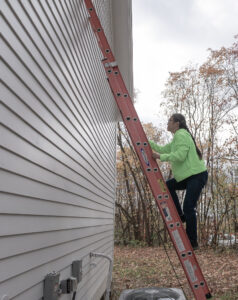
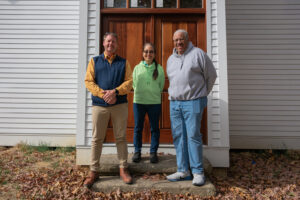
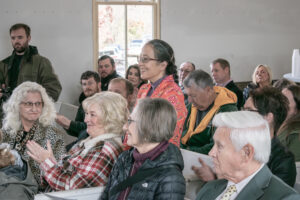
Left: Charissa Durst climbing into the attic during the final punch inspection on 11/7/2025. Center: Contractor Dan Mullins (left) and project manager Lacy Ward (right) with Charissa Durst on the church stoop after the punchlist. Right: Charissa Durst standing at the Jubilee celebration.  All photos by Jason Lucas.

Hardlines Design Company Inducted into Lincoln Theatre Walk of Fame!

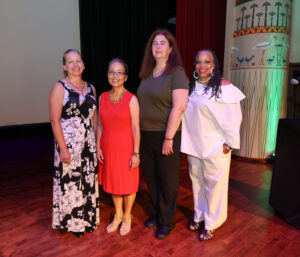
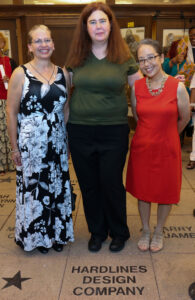
On July 26, 2025, Hardlines Design Company was honored by having our name included on a paver in the Walk of Fame area under the marquee at the Lincoln Theatre. Also inducted were the artist Elijah Pierce, whose family flew in from Texas to attend the ceremony, and the architecture firm Moody Nolan, represented by Jonathan Moody, son of founder Curt Moody. President Charissa Durst and Project Architect Vivian Majtenyi, both of whom worked on the Lincoln Theatre rehabilitation, were present. Jennifer McAdam of HDC also attended, which was her first (but hopefully not last!) visit to the Lincoln. In her speech, Executive Director Suzan Bradford stated that she always thought HDC should have had their name on the building somewhere, only to find out that Vivian had included the name of the contractor and HDC in hieroglyphs around the auditorium doors, and was now pleased that HDC’s name is now a permanent part of the building site. We at HDC are now looking forward on collaborating with Suzan on a book to mark the 100th anniversary of the building in 2028!
   
L: Jennifer McAdam, Charissa Durst, Vivian Majtenyi, and Suzan Bradford on stage at the Lincoln Theatre. R: Jennifer, Vivian, and Charissa with the HDC paver under the marquee.

Making Historic Buildings Accessible

On a recent episode of WOSU’s All Sides with Anna Staver experts in historic preservation discussed the difficulty in making historic buildings fully accessible. Typically these challenges come from a  combination of lack of space and desire to not alter the historic character of the exterior. One of the first issues to consider is getting someone in a wheelchair from their car to the building entry, which typically involves restriping to provide a van-accessible parking space with signage and a curb ramp. Making an entrance accessible can involve, generally from most to least expensive: a new addition with an at-grade entry, a wheelchair ramp with 12” of length for every inch of height plus landings, an exterior mechanical lift, or a portable wheelchair lift. Although the last option is the least expensive and requires the least alteration of historic buildings, it does not allow the person in a wheelchair to enter the building without assistance. Once inside the building, we have to provide restrooms with space for a 60” wheelchair turn radius, provide at least 32” of clear space at door openings, and provide an elevator or lift to access multiple floors, among other items.

Hardlines Design Company has designed several accessibility solutions to meet different needs and budgets.

     
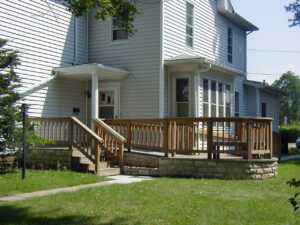
Left: A wheelchair ramp designed for Newark Resident Homes, where the ramp landing incorporates a deck for the residents. Right: Side elevation of the Davis-Shai House where a wheelchair ramp provides access to the new elevator, whose shaft is tucked discreetly at the juncture of the gable roofs.
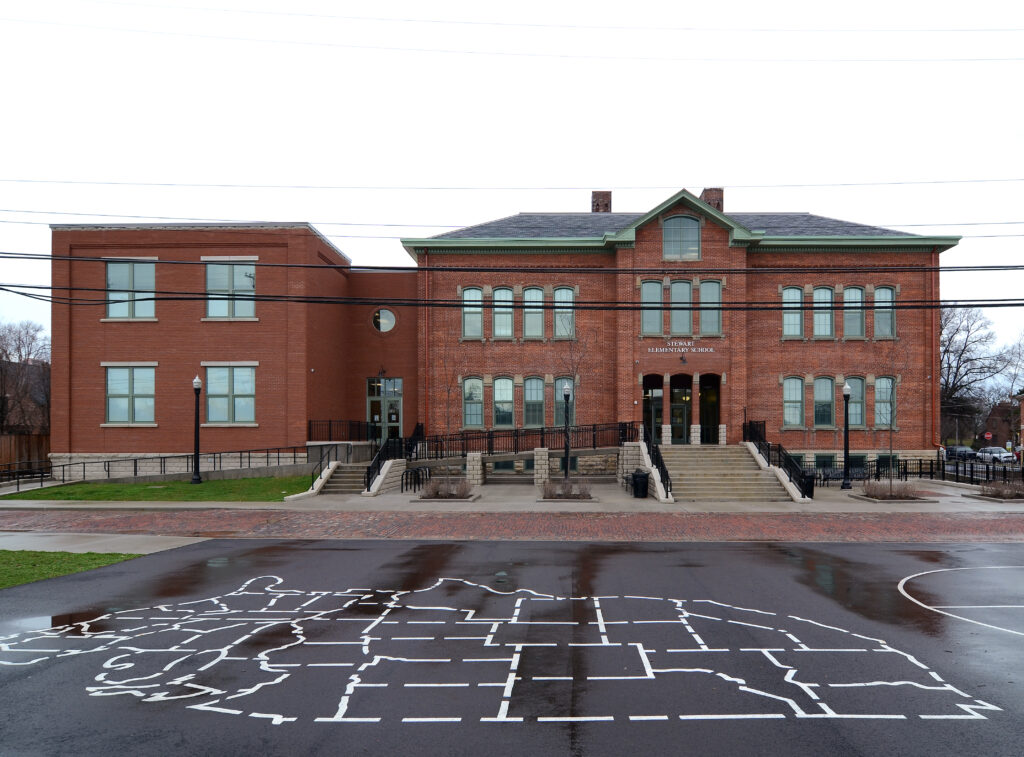
Stewart Elementary School with new ramp and steps to doors at the addition and historic building from the parking lot and parent drop-off to the left.
A separate ramp at the right provides access to the cafeteria in the lower level.

HDC Welcomes Back Vivian Majtenyi!

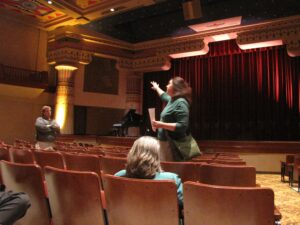
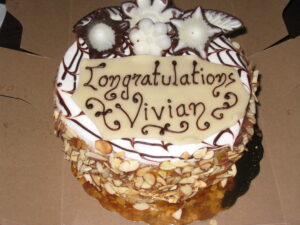
The void left by the passing of Cathie Senter was thankfully filled by the return of Vivian Majtenyi in March. Vivian worked for HDC from 1999 (we were her first full-time architecture position) until 2013, when she left to take a break after working almost non-stop on our signature projects. During her 14 years at HDC, she traveled the country to complete facility assessments on Air Force Materiel Command installations and conduct research and documentation of historic buildings on navy bases. Vivian worked with Charissa Durst on the initial fieldwork at the Woodward Opera House through the rehabilitation of the second floor. She was also the project coordinator for both the addition to and renovation of the Lincoln Theatre and the addition and renovation of Stewart Elementary School. Vivian also obtained her architecture license in 2011. In the 10 years since she left HDC, her diverse work experience included the in-house design department of a construction firm, a large (over 650 employees) full-service A/E firm, and researching and writing historic architectural reports for cultural resources projects. Since HDC started new projects with the City of Columbus and State of Ohio this year, we are very happy to have Vivian back!
  
Left: Vivian leading a tour of the Lincoln Theatre. Right: Vivian’s celebratory cake upon passing the architecture license exam.

Office Dogs Supporting HDC Projects

HDC had previously posted a blog on the benefits of having a dog in the office, but what about bringing a dog onto the job site? It turns out that HDC’s office dogs have a long history of tagging along to job sites, especially those located in rural areas or near parks. Here’s a summary of the adventures of Bagle, Donut, and Ziti on job sites.

Bagle the Beagle

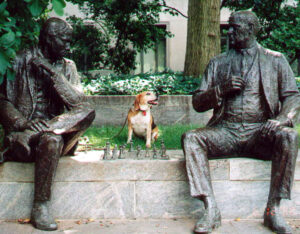
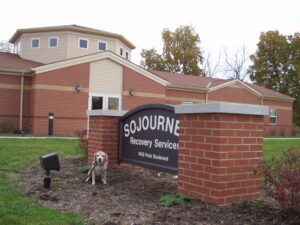
Bagle was with the office from 1992 to 2004. During the 1990s, HDC conducted numerous historic building inventories and evaluations for the Wayne National Forest in southern and southeastern Ohio. In one memorable trip she had to be carried over the metal pedestrian bridge over the creek because instead of a deck, it had rungs like a ladder. On the return trip, Bagle chose to cross the shallow waters. Bagle also got posed in front of numerous monuments in Washington D.C. as well as HDC’s first project with the State of Ohio and our first new construction project, the 7,000-square-foot outpatient center in Hamilton, Ohio.
  
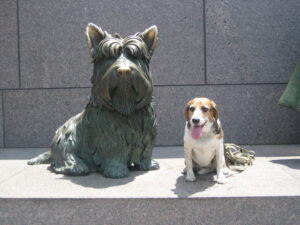
At left, Bagle the Beagle referees a chess game in Washington, D.C. in 2000 and at right, in front of Sojourner Center in Hamilton, Ohio, in 2001.

Donut the Beagle

Donut’s tenure with HDC lasted from 2004 to 2018. During this time, HDC worked on many projects for ODOT and completed our first project with ODNR at the Day Lodge in John Bryan State Park. Donut came to many meetings in John Bryan State Park. If it was cool she stayed in the car. If it was warm she ended up under a big tree tethered to the picnic table. On warm days she could hear the meeting in progress through the open windows and barked loudly to express her displeasure at being left out. As a result, meetings finished quickly so that “poor Donut” could go for her walk in the park. Donut’s biggest contribution to the office was to bark while president Charissa Durst was on the phone with an ODOT auditor, who was demanding more paperwork to support a change order. Once the auditor was told the “noise” was the office beagle, he calmed down and mentioned he had a beagle growing up and assured us he would take care of the change order. Our payment arrived within a week!
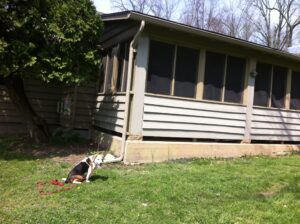
  At left, Donut poses next to a statue of Fala at the Franklin Roosevelt Memorial in Washington, D.C. in 2010, and at right, by the Day Lodge porch in John Bryan State Park in 2017.
Ziti the Noodle Dog

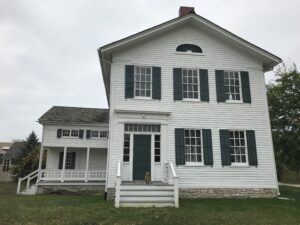
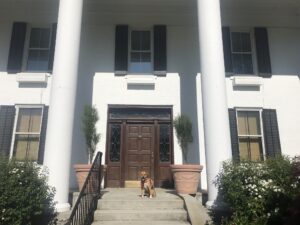
Since Ziti grew up with her littermates for 9.5 weeks, she is used to being surrounded by others. We used to joke that Donut had FOMO (fear of missing out), but Ziti definitely has a fear of being left out! As a result, she accompanies Charissa Durst everywhere she goes, even if Ziti just ends up waiting in the car in a parking garage. Fieldwork trips where Ziti was a big hit with clients she met on site at the Macedonia Missionary Baptist Church in South Point, Mount Zion Baptist Church in Athens, and the Lathrop House in Sylvania. Ziti loves when our projects are located in parks!
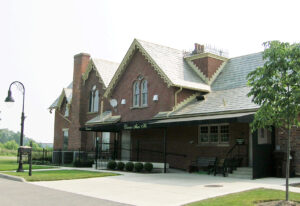
  At left is Ziti at the Lathrop House in 2020, which is in Harroun Park in Sylvania and at right she is in front of the Meade House in 2021, which is in the Meade Historic Preserve in Symmes Township.
HDC Documents Another Building at Taylor Farm Park

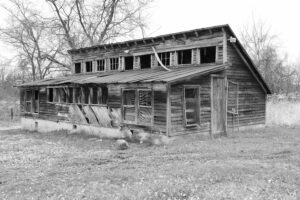
HDC is working with the City of New Albany to document the Chicken House at Taylor Farm since the building sits in the flood plain and may have to be moved or reconstructed at another location. The design for this half-monitor chicken house was invented by the University of Illinois Extension and became quite popular on rural properties in the Midwest throughout the 1920s. Since these buildings typically did not have electricity, the south-facing windows let in plenty of light to warm the nesting boxes used by the hens along the north wall in the winter. The high windows in the monitor draws hot air up and out for ventilating to keep the hens cool during the summer. The steep north roof causes cold north winds to blow over the building and there are no windows on the north wall. This building sits on a concrete foundation that features three square openings under the south-facing windows that allowed the chickens free access into the yard. The interior would have been divided into three individual rooms with removable walls for easy cleaning.
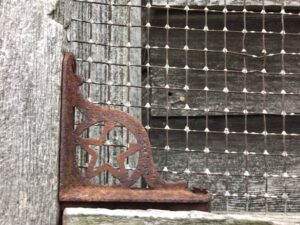
  At left is an archival photograph of the southeast corner by Jeff Bates and at right is a cast iron corner brace at the screen door.