Tag Archives: Hardlines Design Company
Progress Continues at Northcoast Behavioral Health Dietary Building

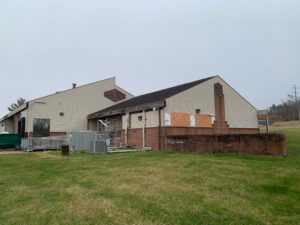
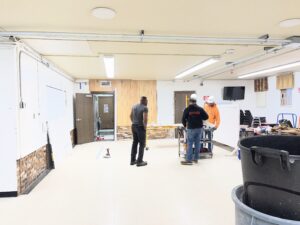
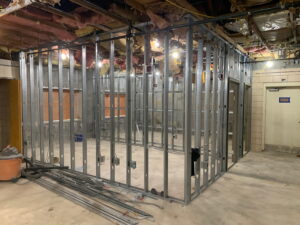
The project recently expanded to include replacement of the existing restroom fixtures and partitions, which everyone thought would look very dated when seen next to the renovated office area around it. After demolition was completed in the kitchen areas, work started on framing the new office walls for the new office suite. This included updating the existing window wall while retaining the existing wheelchair ramp, which provides accessible entry to restrooms for workers in the maintenance building in the rear. Construction is anticipated to be completed in Fall 2026.
      Left: Exterior windows and wall being updated. Right: Framing for new offices where the two windows are being updated.

All THAT Teen Center Construction Starts Up Again

After the roof replacement, construction at the All THAT Teen Center went on hold as discussions took place with the City building department on whether the project needed a site compliance plan review. Finally, the building department agreed that since there was an ownership change and not a use change (building was still leased by a church for Sunday services), a site compliance plan was not required. However, since the classrooms were used for after school activities and not Sunday school activities, the examiner required that each classroom have an individual smoke detector in addition to the fire alarm system and rated corridor doors already in the project. After the updated fire alarm plans were approved, construction could finally start on the last phase of the project, which is now scheduled to be completed in January 2026.
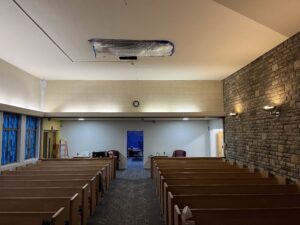
   
Left: New classroom walls going up at rear of sanctuary. Center: New restroom partitions in lower level. Right: Multi Purpose Room renovations underway.

Zanesville Historical Marker Moves Forward

HDC was successful in getting the Downtown Zanesville Historic District listed in the National Register of Historic Places in 2024, but one final piece of mitigation remained outstanding: the Ohio historical marker. Ohio historical markers started in the 1950s, born from the 1953 state sesquicentennial, to document important people, places, and events, with the first marker placed in 1957 for Akron’s Portage Path, all managed by the Ohio History Connection (formerly the Ohio Historical Society) to tell community stories through Ohio-shaped signs. The program, run on an annual cycle with sponsor-funded markers, now boasts over 1,700 markers, including special ones for the Bicentennial and LGBTQ+ history, making Ohio’s past accessible.
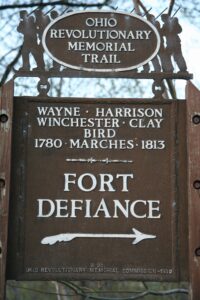
The company that produced the first historical marker is still producing them today. In 1927, E. M. Hawes founded Sewah Studios (his name spelled backwards) in Marietta, Ohio, to create roadside signs and markers for automobile tourists. Hawes researched and developed a cast aluminum process that was lightweight, inexpensive, and corrosion resistant compared to traditional wood, bronze, or ferrous metal signs common at the time. He also sponsored a cash competition where hand lettering artists submitted designs for capital and lower case letters less than 1 inch in size, which did not exist at the time. Hawes chose a winner, made a few changes, and the Sewah script was born. Sewah’s first commission was for over 500 signs for the Ohio Revolutionary Trail Commission in 1929.
One of the original Ohio Revolutionary Trail markers, shot by Dale K. Benington, on April 6, 2010.
The distinctive Ohio-shaped marker was designed by Sewah Studios, who submitted the winning design to the historical marker committee in 1955. They received the contract to cast the first historical marker in Akron and have been producing them ever since. The process consists of hand assembling the letters and images into a pattern, which is then pressed into fine sane to create a mold. Two halves of the sand mold are then clamped together and molten aluminum is poured into the cavity. The raw casting is then sent to the finishing department who adds the colors to the sign.
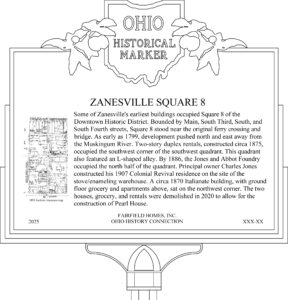
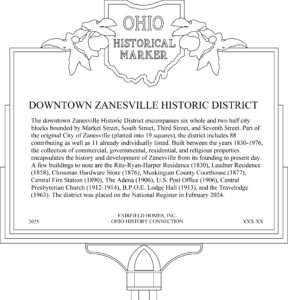
The Ohio History Connection’s marker approval process simply involves approving text not to exceed a specific word count and images of a specific size. However, the City of Zanesville required graphics showing exactly what the sign would look like, so HDC traced the outline of a historical marker in AutoCAD and mocked up the text and image for both the Zoning and Building permits, which were received in November 2025. The marker application was signed soon after and we are waiting on a proposed delivery date.
     
Proposed historical marker Side A and Side B.