
Category Archives: Heritage Tourism
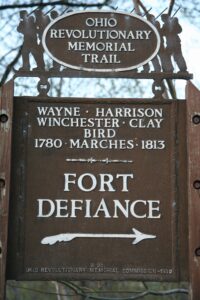 One of the original Ohio Revolutionary Trail markers, shot by Dale K. Benington, on April 6, 2010.
Fall 2018
HDC Staff News
Although Megan Claybon was born and raised in Atlanta, her mother grew up in Upper Arlington and learned to swim at Devon Pool. So it seemed only fitting that Megan coordinate the construction documents for HDC’s project to replace the 1950s pool house with a new building. Just as the project was going into construction after the pool closed before the first day of school, Megan gave birth to Phoebe in August! So, instead of attending progress meetings at the construction site, she is keeping busy with her new daughter at home. We are all thrilled for her adventure in life, but we will greatly miss her at the office!
Prior to coming to HDC, Cathie Senter taught building conservation and preservation at Belmont Technical College in St. Clairsville, Ohio. While she was wrapping up her teaching and housing situation, it seemed logical for Cathie to coordinate the construction documents for HDC’s projects in eastern Ohio: an expansion to the existing paper packing plant at nearby Belmont Correctional Institution and the replacement of exterior stairs at Noble Correctional Institution. In July, Cathie’s dog Casey passed away at the age of 15-1/2 years. Several people at the Harrison County Dog shelter, where Cathie often volunteers, forwarded her information on three Lab/Sharpei mixes that had recently been rescued. Cathie took a fancy to one she called Murphy. Murphy and his brothers ended up at the “Save a Puppy” program at Belmont Correctional Institution, where inmates provide obedience training and socialization. Cathie was able to meet with Murphy and his trainer while attending job meetings on site, and after Murphy graduated in August, she brought him to his forever home in Columbus.
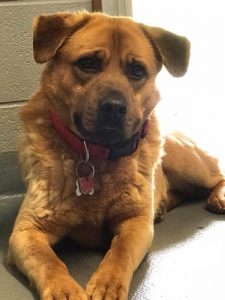

Murphy alone (left) and with Cathie (right)
For their 13th wedding anniversary, Charissa Durst and her husband took a driving trip north to Michigan. They attended the Cherry Festival and visited Sleeping Bear Dunes National Park and then Pictured Rocks National Lakeshore in the Upper Peninsula. Bookending the trip was the initial stop at the Air Zoo in Kalamazoo and the final stop at the Henry Ford Museum in Dearborn, where there was an exhibit on Charles and Ray Eames.


Air Zoo exhibits (left) and an Eames furniture exhibit (right)
HDC works with Commonwealth Heritage Group on the Ballville Dam
HDC continues to work with Commonwealth Heritage Group on the historic documentation of the Ballville Dam, which was proposed for demolition to restore the natural flow of the Sandusky River near Fremont, Ohio. HDC is providing the drawings. Charissa Durst visited the site in 2017 to obtain information and start the drawings. The dam was demolished in July and HDC visited to check conditions that were not previously visible. The drawings are scheduled to be completed this fall.
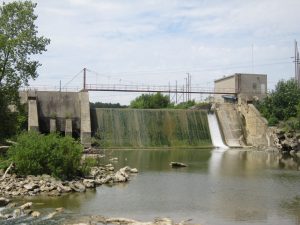
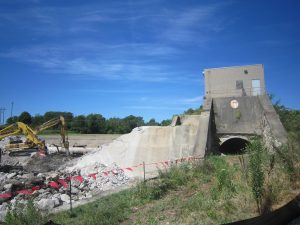
The dam before demolition in August 2017 (left) and during demolition in July 2018 (right)
HDC Starts Work on the USAF Alert Facility Cold War Museum in Blytheville, Arkansas
In 2016, a pilot and volunteer interested in saving the 1950s Alert Facility on the former Eaker Air Force Base in Blytheville contacted HDC about preparing a study to determine the costs to rehabilitate the abandoned building into a museum. HDC visited the site and provided information on the costs needed for a study. The project moved forward in the April 2018 when HDC made a presentation to the board about the work needed to complete the study. In three months, the funds were raised to commission HDC to prepare the study, and Charissa Durst and John Creasy drove down to Arkansas to conduct field work. By happy circumstance, at the WPO conference in Los Angeles, Charissa Durst sat next to A.J. Goehle, the executive director of Luci Creative, who happen to be museum designers with military project experience. HDC has partnered with Luci Creative to provide recommendations and budgets for the museum’s future exhibits. The goal of the museum is to provide a memorable experience on what it was like to be on 24-hour alert to defend the United States from a Soviet attack.
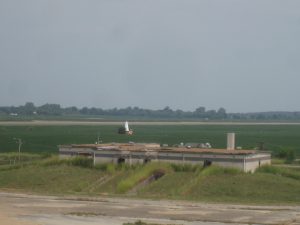
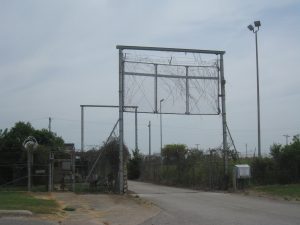
Alert Building from the Guard Tower (left) and one of the security gates that will be part of the visitor experience
Donut Runs (Almost) Free in the Park
Throughout the summer, Donut often goes to the Prairie Oaks Metro Park on the weekend. In June, before it got really hot, she happily ran down the mowed paths on the prairie section. Donut has always been an unusual beagle in that she doesn’t wander off on her own. We often drop her 40-foot leash and let her run ahead before calling her back for a treat—her absolute favorite park activity. Later, when it became really hot, Donut would end up in Big Darby Creek getting a drink and cooling off, her second favorite thing to do at the park.
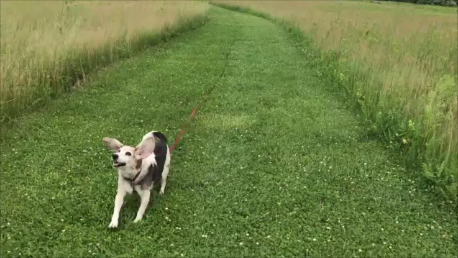
Donut running with ears flapping
Hardlines President Charissa Durst co-hosts design:ROLLS this Sunday!
(originally posted by Andy Sewell on October 1, 2014)
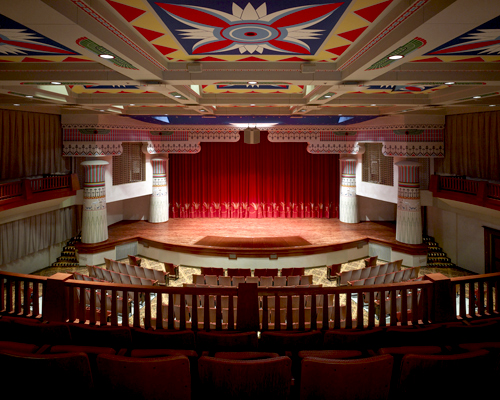
This Sunday, October 5, 2014, Hardlines Design Company President Charissa Durst will be the “host” at the Lincoln Theatre, one of seven stops for the design:ROLLS bicycle tour of downtown architectural projects. The bicycle tour starts at 1 P.M. at the The Center for Architecture and Design, 50 West Town Street.
The itenerary includes the following stops:
Cristo Rey/Old School for the Deaf: Built in 1899 and renovated 2014
Columbus Museum of Art: Built in 1932 and renovated in 2012
Long Street Cap and Cultural Wall: Built 2014
Lincoln Theatre: Built in 1928 and renovated in 2009
Yellow Brick Pizza: Significant for yummy pizza!
Trautman/250 South High Street: Built in 2014
Land Grant Brewery: Built in 1921 as Capital Lift and Manufacturing Company, renovated in 2014
Tickets are still available at the Center for Architecture and Design website: http://www.columbuscfad.org/designrolls/
I Slept in a Wigwam
(by Maria Burkett, originally posted March 1, 2012)
Route 66 is a treasure trove of American mid-century vernacular architecture. Many songs and movies have been made about traveling the historic route, which runs from Illinois to California. Built in 1926, the route has long passed its heyday, but it is still a bastion of culture for any fan of mid-century modernism.
I love signs–here’s one marking Route 66.I was so excited to be staying in an icon of the Mother Road.
Several years ago, I was in California doing fieldwork for a cultural resources assignment for Hardlines Design Company, and I found myself driving along Route 66 in San Bernardino, looking for a place to spend a few nights. After a little research, I made an amazing discovery: one of the original Wigwam Motels is located along Route 66 in Rialto, California, just outside of San Bernardino. I immediately booked a room. For any of you who are fans of the Disney movie Cars, the Traffic Cone Motel was modeled after this.
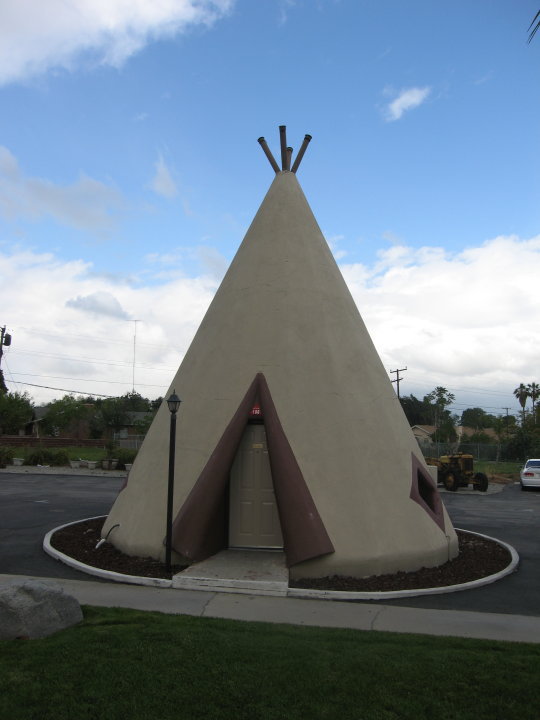
Seven Wigwam Motels were constructed across the country between the 1930s and 1950s to serve as roadside stops for people along the new highway system. The first Wigwam Motel was constructed in Horse Cave, Kentucky, in 1933 and is sadly no longer standing. The one in Rialto was constructed in 1949 and was the last of the motels ever built. Today, only three Wigwam Motels remain, located in Cave City, Kentucky; Holbrook, Arizona; and the one in Rialto where I stayed. The motels are all situated along popular early highways and are (or were) surrounded by other interesting roadside attractions. (For more on this topic, check back for future posts in this series.)
The wigwam motels were all constructed of poured concrete and then painted. They have a round plan and are a single story tall. The design for the wigwam’s was patented in 1935, and all of the wigwams were constructed exactly the same, with the only variety being the front office and the layout of the individual wigwam buildings.

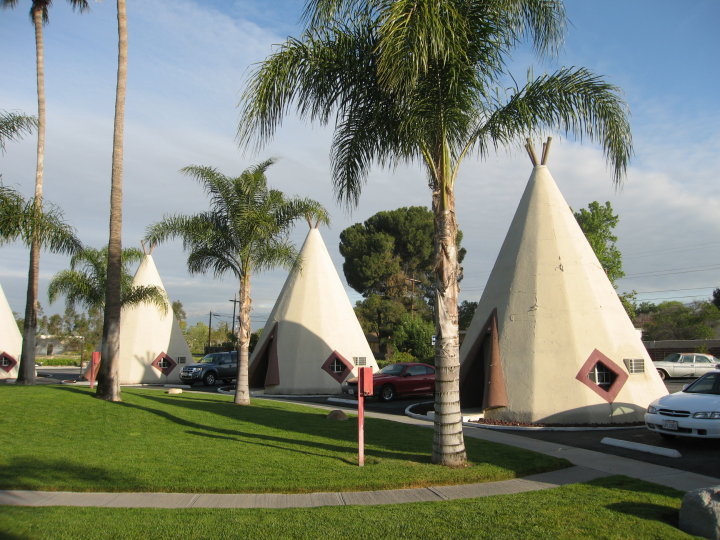
Several of the wigwams at the Rialto motel
Wigwam Motel No. 2 in Cave City, Kentucky. Unfortunately, I did not sleep in these wigwams; I just drove past them on the way to Mammoth Cave about five years ago. While the wigwams have an identical design, the layout and setting is much different than the one in Rialto. All of these wigwams are in a single arched row around a large central wigwam, and the motel is in a more residential setting, surrounded by mature trees.
The Rialto motel is located in a commercial area of the city near fast food restaurants and car lots and is a distinctive landmark for residents. The motel is laid out as a series of teepee-shaped rooms around a central rental office and pool. Each wigwam consists of a single room with a small bathroom. The rooms have the original western-style furniture, including a wigwam-shaped mirror. One thing I was surprised about was the low ceiling; the room is not open all the way to the top.
The complex is in excellent condition and is lucky to have owners that care for the history and the future of the motel. The wigwams were meticulously restored several years ago by the present owners, and the complex was listed in the National Register on January 3, 2012, joining the other two extant wigwam motels.
I enjoyed sleeping in a Wigwam and would like to repeat the experience again in the future! Have any of you ever slept in a wigwam? What did you think of the experience? For more information on the history of the motel, or if you’re in Rialto and want to sleep in a wigwam, click here for the Rialto Wigwam Motel’s website.