HDC prepares National Register nomination for a Downtown Zanesville Historic District
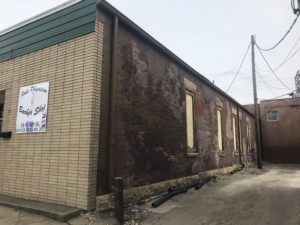
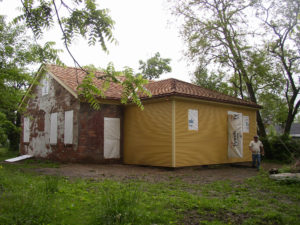
In December of 2019, HDC was commissioned to prepare the Section 106 documents needed for construction of the Pearl House in Zanesville, which required the demolition of three historic buildings on the block. HDC inventoried the three buildings and prepared a Memorandum of Agreement that stipulated a district nomination as mitigation for the loss of the three buildings. HDC advised the client to apply for a Pipeline grant from the Ohio Department of Development to help fund the nomination, which was approved in November of 2021. The district contains over 90 buildings, with contributing buildings constructed between the 1830s and 1970s. Some of these buildings are already individually listed in the National Register and retain much of their historic character while others were modernized in the mid-20th century by removal of the top floors and construction of a new flat roof–AKA when the “buzzsaw of death” visited Zanesville.

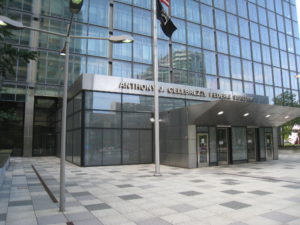
Left: This intact block of buildings on Main Street is fronted by the Ohio Power Building (built 1929), which is individually listed in the National Register. Right: This small building still retains 1890 sandstone lintels and sills from when it stood three stories in height as the Central Fire Station.
HDC Looks Back On and Forward to Black History Projects
In recognition of Juneteenth this month, HDC looks back on our projects that were associated with Black history.
In early 2002, HDC started a project to prepare a renovation master plan for the Gammon House in Springfield, Ohio. The Gammon House was built in 1850 by George Gammon, a Black abolitionist and is one of the few Underground Railroad sites in Ohio that was owned by a free person of color. HDC subsequently implemented the first phase of the renovation plan to stabilize the exterior.

The Gammon House before (left) and during (right) stabilization in 2007.
In 2003, HDC was commissioned to prepare a feasibility study to renovate the Lincoln Theatre in Columbus into a modern performing arts center. The Lincoln Theatre, an Egyptian Revival theatre that opened in 1928, was funded by a Black developer, designed by a Black architect and built by a Black contractor. HDC’s study was used to secure funding from the City of Columbus and Franklin County, with the remaining funds raised by private donors. The grand re-opening occurred in 2009, and the project received awards from Columbus Landmarks Foundation, Heritage Ohio and the Ohio Historic Preservation Office.

The interior of the theatre before (left) and after (right) rehabilitation in 2009.
In 2005, the City of Wichita commissioned HDC to prepare a redevelopment study for the Dunbar Theater, which was constructed in 1941 and named after Paul Lawrence Dunbar, the Black poet and author from Dayton, Ohio.
It was the focal point of a commercial and entertainment hub that served the McAdams neighborhood and surrounding neighborhoods that were predominantly African-American in origin until 1963, when the theater closed. Power CDC, a developer that specializes in inner-city Wichita, acquired the building in 2007 and restored the façade and marquee in 2012-2014.

The Dunbar Theatre continues to be a work in progress.
In 2007, HDC prepared a Historic Structure Report and implemented the stabilization and exterior rehabilitation of the Lathrop House, which was built c. 1850 by Lucian Lathrop, a prominent white abolitionist in Sylvania, Ohio. The house contains an Underground Railroad Museum in the new basement and HDC completed an update to the Historic Structure Report in 2021 to rehabilitate the interior of the house and make it accessible.
The Lathrop House before (left) and in 2021 (right).
In 2017, HDC prepared a master plan to rehabilitate the Ozem Gardner House in Sharon Township near Worthington, Ohio, which was built in the 1840s by a local abolitionist, into offices for the Flint and Walnut Grove Cemeteries. The Gardner Family donated the original land to create the cemetery in 1821. The pandemic set the project back from its goal of opening in 2021. It is currently anticipated to be completed in 2022.

The Ozem Gardner House before (left) and after restoring the original masonry window openings (right).
In 2020, the City of Athens commissioned HDC to prepare a renovation master plan to convert the Mount Zion Baptist Church, built in 1904 by a Black congregation, into a community center and museum of African American Appalachian culture. The study was used to obtain a grant from the National Trust for Historic Preservation to start the rehabilitation process.

The Mount Zion Baptist Church in Athens, Ohio.
HDC recently worked with architect O.A. Spencer on the interior renovation of the Martin Luther King Jr. Performing and Cultural Arts Complex in Columbus, whose mission is to connect community through the arts by engaging central Ohio through performing, cultural and educational programs of high artistic merit that increase and disseminate knowledge regarding the vast and significant contributions of Black Americans to the culture and history of America and the world.

The main Auditorium with new flooring, ceiling and lights, looking through the updated column (left) and looking into the Lobby past the mural by artist Wali Neil (right). Photos by Shellee Fisher Photography.
And finally, HDC is very honored to have been awarded the project to prepare a Historic Structure Report of the Macedonia Missionary Baptist Church in Lawrence County, across the Ohio River from Huntington, West Virginia. The church was built c. 1849 and is one of the first Black churches constructed west of the Appalachian Mountains. The team is looking forward to starting work in August!

The Macedonia Missionary Baptist Church in South Point, Ohio.
HDC Celebrates nearly 30 Years of Partnership With Photographer Jeff Bates
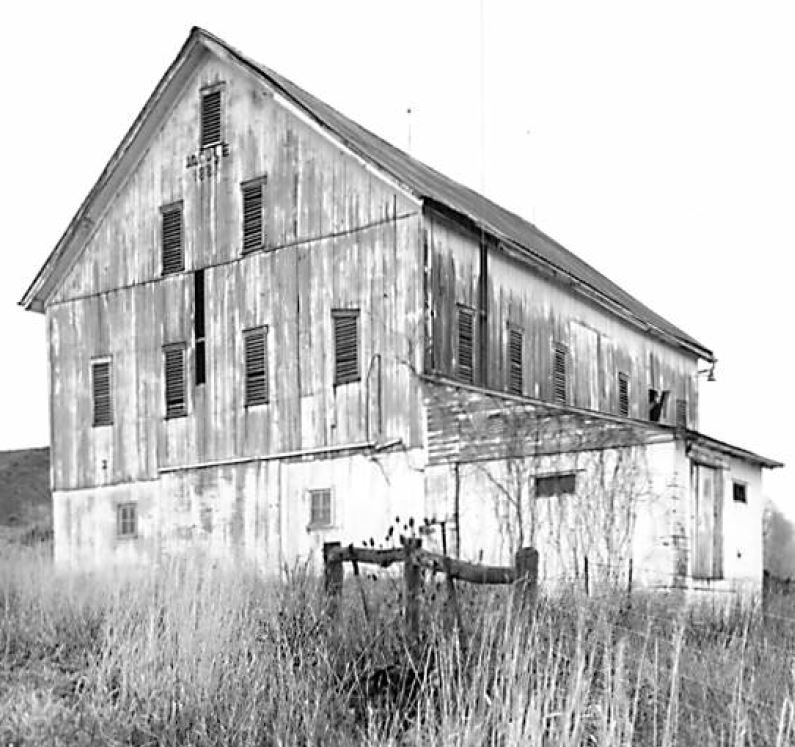
Our first project with photographer Jeff Bates occurred way back in 1994 for the Historic American Buildings Survey (HABS) documentation of the J.O. Cole House near Smithfield in Jefferson County, Ohio. The property had been continuously occupied by the Smith family from 1845 to 1967, when the property was conveyed to a coal mining company.

The 2-story wood frame house was constructed in 1881 and features fine Italianate detailing in the eave brackets. The 4-story barn bears the name “J.O. Cole” on the gable end.
Jeff also travelled with us as we documented buildings for the Air Force and Navy in the 1990s. In the 2000s, Jeff photographed many large and small historic bridges for our Ohio Department of Transportation projects, as well as ongoing work at Wright-Patterson Air Force Base.

A “demountable” hangar at Reese Air Force Base, Texas, and Jeff on a forklift to get a good overall interior shot in 1996.

In 2000, Jeff shot the Grant Suspension Bridge from a helicopter for ODOT.
In the 2010s, Jeff helped HDC prepare HABS documentation for projects in the City of Columbus at the request of the Ohio Historic Preservation Office, as well as documentation of buildings at The Ohio State University prior to their partial or total demolition.


Left: The main stair of Brown Hall, built in 1903, that was demolished in 2009 along with Lord Hall to create more green space. Right: The ceiling of the WWI Memorial rotunda in Sullivant Hall that had to be removed for the building renovation in 2011.
Jeff also flew to Fairbanks, Alaska, to document a hangar at Eielson Air Force Base for the Alaska Air National Guard in 2016, and most recently, Jeff shot the high-resolution TIFF files for HDC’s National Register nomination for the Baker Brothers Wholesale Grocery in Zanesville and the Downtown Zanesville historic district nomination.

The Muskingum County Courthouse at the center of the proposed historic district in downtown Zanesville.
Ziti the Noodle Dog is Three Years Old!
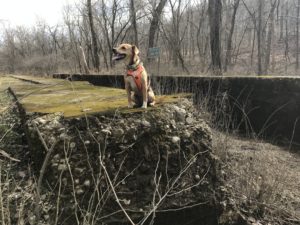
Ziti is affectionally known as the Noodle, and has been called the Noodle Dog in her agility class when an instructor could not get her name out. She turned three years old on Sunday, March 6, which she spent exploring portions of the south end of the Ohio and Erie Towpath Trail in Tuscarawas County, Ohio. It seemed like she knew it was a special day since she climbed up on logs and posed on lock walls without being told, all in the hopes of getting a treat after the photo!
Ziti on top of a fallen log on the towpath (left) and perched on the walls of Lock 10 (right).
Meticulous Details Help with Construction Documents
HDC completed the CAD drawings of the plans and elevations for the exterior repairs of the Kentucky Capitol Annex building in Frankfurt. HDC is a consultant to THP Limited, Inc. who requested that we draw every block of limestone on the elevations. HDC’s John Creasy was up to the challenge, having previously prepared elevation drawings of the former Sears Department Store in Cincinnati, where THP requested that we draw every single brick! John said the Annex building was pretty tricky, with several wall areas hidden behind balustrades or in courtyards.
CAD drawing of the north (front) elevation of the Kentucky Capitol Annex building.
Teaming with Karpinski Engineering
HDC first worked with Karpinski Engineering in 2007, when we provided architectural support to the HVAC project at OSU’s Campbell Hall. The project was being managed by Karpinski’s newly opened Columbus office. HDC then teamed with Karpinski’s home office in Cleveland to implement the first phases of the master plan for the Five Oaks Historic Home in Massillon in 2011. Since then, we’ve been Karpinski’s architectural consultant for a project to renovate labs at OSU’s Biomedical Research Tower. Karpinski has been our MEP consultant on the Gardner House in Worthington, Mount Zion Baptist Church in Athens and the Governor’s Residence Pergola and Portico in Bexley. HDC is currently working with Karpinski Engineering on a renovation for Northcoast Behavioral Healthcare in Northfield, Ohio.
Main entry of Campbell Hall (left) and the interior of Five Oaks Historic Home (right).
Architectural Styles and Building Types in Louisville, Kentucky
HDC first started working with C&S Engineers on the residential sound insulation project for the airport in Louisville, Kentucky, in 2007, and since then, we have completed the inventory and evaluation of 907 buildings. The initial project resulted in the inventory of 374 buildings over four phases of work. A separate project in 2011 resulted in the determination that 30 buildings in the North Audubon Park neighborhood were not eligible for the National Register as part of the Audubon Park Historic District, which was listed in the National Register in 1996. In 2017-2018, HDC investigated eight buildings located on the University of Louisville campus. This last project saw the inventory of 495 buildings in 6 phases, with 291 of these buildings being recommended as eligible as part of the Schnitzelburg Historic District.
Building types encountered include shotgun houses, American Foursquare houses, Bungalows and Cape Cod houses. Architectural styles are typically from the early twentieth century and included Colonial Revival, Prairie, Mission and French Eclectic.
There are only three shotgun homes in the project area, all built at height of the style’s popularity. Two homes were built in 1918 and one was built in 1922. The earlier homes are less than 15 feet wide, while the later house is over 20 feet wide. The shotgun house was popular with developers of lower income neighborhoods since they could cut costs by squeezing more homes onto smaller plots of land.
Most of the homes in the project area were designed for more middle-class buyers, and many were one-and-one-half story bungalows of various styles. The term “bungalow” came from in Bengal, India, in the late 19th century and referred to a small house meant as a temporary resting place for travelers. In 1906, an article appeared in a popular style magazine that contemplated the use of the bungalow as a permanent dwelling. These small houses emphasized simplicity, informal living and natural materials, and therefore became very popular with developers of middle-class neighborhoods.
A grander home style popular in the early 20th century is the American Foursquare, which is typically two-and-one-half stories tall with a raised basement. The developer’s costs were contained by the simple cube shape of the house, which was typically topped with a hip roof.
A small Bungalow house (left) and a larger American Foursquare (right).
The Cape Cod house emerged in the 1920s but gained popularity as a model home for planned communities after World War II. They are typically Colonial Revival in style, as they were inspired by cottages on Cape Cod in Massachusetts and the Tidewater area in Virginia. This house type generally is one-and-one-half stories in height with a steep gable roof (either front facing or side facing).
A simple side gable Cape Cod home (left) and a more detailed front gable version (right), both in the Colonial Revival style.
Miscellaneous building types and styles encountered in the project area include the Brutalist style seen on 1970s era educational buildings on the University of Louisville Campus. This style was popular in the 1950s-1970s, possibly as a reaction against the nostalgic “revival” styles popular after World War II. This style typically features exposed concrete and simple, geometric forms. There are about a dozen multi-family apartment buildings in the project area, most built in a traditional Colonial Revival style, although many were more eclectic, with tile roofs hinting at Spanish or Mediterranean Revival architecture. A unique Mission style building is located in the North Audubon neighborhood.
A Mission style apartment building on Audubon Parkway (left) recommended as contributing to the Audubon Park Historic District and Brutalist Style Interfaith Mission Center built in 1974 on the University of Louisville campus (right).
Sanborn Fire Insurance Maps Shed Light on Neighborhood
HDC is in the process of finalizing an individual nomination of the Baker Brothers Wholesale Grocery building in Zanesville, Ohio, located just east of the historic Y bridge on Main Street. The building was constructed in 1894. After the 1913 flood that destroyed much of downtown Zanesville, the Baker Brothers constructed an addition in less than a year and encouraged other businesses to rebuild. The company remained in business until closing in 1970. In 1978, a one-story addition was constructed on the west side of the building as a furniture showroom. The building was subsequently renovated for use as offices and a school, with most of the work impacting the 1913 and 1978 additions. The building has sat vacant for the past several years, but the current owner has plans to rehabilitate it!
The 4-story red brick building was constructed in 1894 and the 4-story yellow brick addition was built in 1913 (left). The interior of the original building retains almost all of its historic character (right).
Since the building was built and occupied by one company for decades, Sanborn Fire Insurance maps are particularly useful in determining how the building and neighborhood evolved. The 1886 Sanborn map shows that a glass manufacturing company occupied a large portion of land along the river before the Baker Brothers purchased the parcel at the southwest corner of Main and S. First Street. The 1895 map shows the new building with an elevator and stairs in the rear. The elevator still exists, but the stair run from the first to the second floor was closed when a new stair closer to the center of the building was constructed. The 1919 map shows the 1913 addition and the presence of two new elevators in the addition, one of which still exists.
The 1886 map shows the site occupied by the window glass plant of the Kearns Gorsuch Glass Company.
The 1895 map (left) shows the 1894 building on the site of the former glass factory. The 1919 map (right) shows the 1894 building and the 1913 addition along with warehouses that are no longer standing.
Ziti Looks Back on a Productive 2021

Ziti always looks as if she’s having a blast at The Gated Dock (left). Ziti looking not too impressed at the ribbons she’s racked up for 2021 (right).
Ziti participated in 32 FastCAT races and earned enough points to achieve BCat, DCat, and FCAT levels! She is currently the fastest beagle in the country with her fastest three runs averaging 26.07 MPH. Ziti, however, looks much happier actually running the races than posing with her awards.
Click HERE for a copy of the 2022 Ziti Motivation Calendar
Interesting Feature of a Water Meter and Backflow Preventer Building

The southwest corner (left) and interior of the building while under construction (left)
HDC was on M-Engineering’s team to design two buildings to house new backflow preventers and water meters where Ohio State University’s water system connects with the City of Columbus’ infrastructure. Construction completion was delayed due to issues in delivering the specified brick, but the contractor was able to achieve substantial completion in December of 2021. The available infrastructure made traditional floor drains very expensive, so the team was charged with coming up with another solution if the equipment suffered a catastrophic failure and flooded the building.
Our solution: flap valves on the rear elevation that only open with sufficient water pressure!
The southeast corner shows the round openings that are the flap valves that release water during a catastrophic failure
Stained Glass and Faceted Glass at Jefferson Barracks Chapel

The exterior (left) and interior (right) of the chapel at Jefferson Barracks National Cemetery in St. Louis
One of the seven national cemetery locations HDC is investigating with Tetra Tech is Jefferson Barracks National Cemetery in St. Louis. The project here is not the historic superintendent’s lodge, but a chapel built in the 1970s. Since it is such a recent building, the team was lucky to be able to visit the studio of Emil Frei & Associates in St. Louis, the firm that designed and installed the stained glass windows in the 1970s and the faceted glass skylight in the early 1980s. In addition, Stephen Frei led our tour and demonstrated how faceted glass is made by chipping away at a 1″ thick block of glass. He also came to the site to inspect the skylight, which he himself had personally installed. Stephen Frei also explained how the stained glass trees around the perimeter were intended to blend in with the trees outside and that the faceted glass skylight was renamed “The History of Humanity” from “The History of Religion” to be accepted for use in a federal building.

The faceted glass skylight in the chapel (left) and Stephen Frei explaining how faceted glass works (right)